

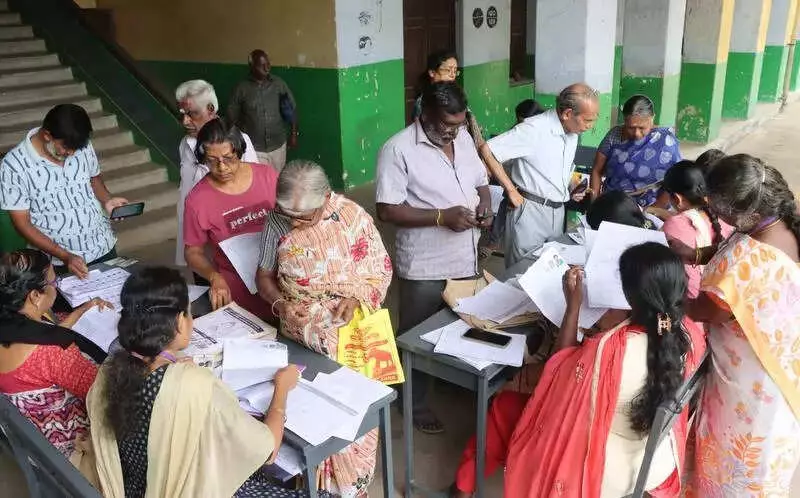
Tamil Nadu's chief electoral officer, Archana Patnaik, announced on Friday a significant revision in the state's voter list following a contentious Special Intensive Revision (SIR) exercise. The draft electoral roll now stands at 5,43,76,755 voters, a sharp decline from the previous count.
Massive Deletions from Voter Rolls
Prior to the SIR, the poll-bound state had approximately 6.41 crore registered voters. The revision led to the deletion of a staggering 97,37,832 names. Patnaik provided a detailed breakdown of the deletions: 26.94 lakh voters were removed due to death, 66.44 lakh for permanent shifting or migration, and 3,39,278 were duplicate entries found registered in more than one place.
The identification of migrated voters was based on three rounds of rigorous door-to-door verification across the state, which found 66,44,881 persons not residing at their registered addresses.

Political Firestorm and DMK's Opposition
The SIR in the DMK-ruled state was conducted amidst fierce opposition from Chief Minister M.K. Stalin. His party had filed a petition in the Supreme Court against the exercise, which it views as a targeted purge of legitimate voters.
"To prevent this anti-democratic move, we convened an all-party meeting and passed a resolution condemning the SIR," Stalin stated. He accused the Election Commission of a "well-planned strategy to delete legitimate voters" just months before the election, alleging the same tactic was used earlier in Bihar.
Stalin also took aim at political rivals, accusing AIADMK general secretary Edappadi K. Palaniswami of "playing a double game" and being afraid of the EC due to his party's ties with the BJP.
National Context: SIR in Bengal and Parliament Debate
The controversy is not confined to Tamil Nadu. On Tuesday, the Election Commission published a draft list of deleted voters after a similar SIR exercise in West Bengal. The issue was also debated at length during the Winter Session of Parliament.
Leader of the Rajya Sabha, JP Nadda, along with other NDA ministers, urged opposition parties to support the SIR. Citing ECI data, Nadda highlighted how West Bengal's electorate had surged from 4.8 crore to 7.6 crore since the last SIR in 2002, with border districts seeing increases of 70% to over 105%.
What is the Special Intensive Revision (SIR)?
The Election Commission of India conducts a Special Intensive Revision of electoral rolls to ensure accuracy before major polls. Mandated under the Representation of the People Act, 1950, it involves door-to-door verification by booth-level officers to enroll new voters and remove entries of the deceased, those who have permanently shifted, and duplicates. The goal is to maintain the integrity of the electoral roll and reflect the most current demographic data.
The process in Tamil Nadu and Bengal has now moved into the claims and objections phase, allowing citizens to contest their inclusion or exclusion from the draft list.






