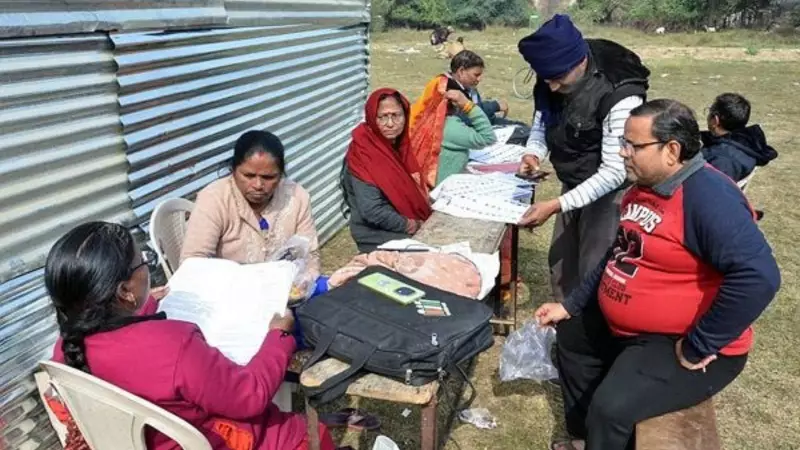
The first draft of Uttar Pradesh's revised electoral rolls, published after a Special Intensive Revision (SIR) exercise, reveals a significant and uniform decline in voter numbers across the state, including in districts with a high concentration of Muslim population. The overall deletion rate stands at 18.70%, a figure mirrored closely in minority-dominated areas, dispelling notions of a skewed purge.
Uniform Deletion Pattern Across Demographics
Data shows that the average decline in voters across ten districts where Muslims constitute between 33% to over 50% of the population is 18.75%. This is nearly identical to the state-wide average. These districts include Rampur (50.57% Muslim population), Moradabad (47.12%), Bijnor (43%), Saharanpur (41.95%), Muzaffarnagar (41.3%), Amroha (40.78%), Balrampur (37.51%), Bareilly (34.54%), Meerut (34.43%), and Bahraich (33.53%).
Furthermore, among the districts with the highest deletion rates statewide, only two—Saharanpur and Meerut—have a Muslim population significantly above the state average of 19.26%. The top districts for deletions are led by Lucknow (30%), Ghaziabad (28.83%), Kanpur (25.50%), Meerut (24.65%), and Prayagraj (24.64%).

Reasons Behind the Large-Scale Deletions
The Election Commission has clarified that the deletions are primarily procedural. Names have been removed because voters were marked as deceased, permanently shifted, absent, or enrolled in multiple locations. Officials expect the final number of deletions to decrease after the complaints and redressal stages are completed.
Uttar Pradesh has recorded the highest number of deletions among the 13 states and Union Territories where the SIR has been conducted so far, which includes Bihar.
The Case of Balrampur: An Outlier Explained
Balrampur district presents an interesting case. With a 37.51% Muslim population, it saw a 25.98% deletion rate, higher than the state average. Unlike other high Muslim-population districts which are largely urban, Balrampur is predominantly rural. The EC stated that a major reason here was that enumeration forms remained "uncollected."
An official explained that Balrampur's voter list was not properly updated before the SIR began. "There were duplicate voters in large numbers, while details of shifted voters had not been updated. A large number of people in Balrampur work out of the district. Records of even dead voters were not updated earlier," the official said. This is reflected in the district's historically lower voter turnout compared to the state average.
A local BJP leader added that, according to their information, a significant number of forms from women voters were "uncollectable" as they did not provide EPIC details of their parental address or forgot to submit them.
Political Context and Broader Implications
The uniform deletion pattern across different demographic regions is a key finding. The BJP leader from Balrampur noted it was unsurprising, stating, "The Muslim community was alert and had their documents to fill enumeration forms ready."
The SIR exercise and the resulting draft roll, published on January 10, 2026, are a routine but intensive process by the Election Commission to clean up the electoral database. The high deletions in urban areas across UP point to greater population mobility in cities. The commission's focus now shifts to the claims and objections period, where voters can ensure their names are correctly listed for future elections.