

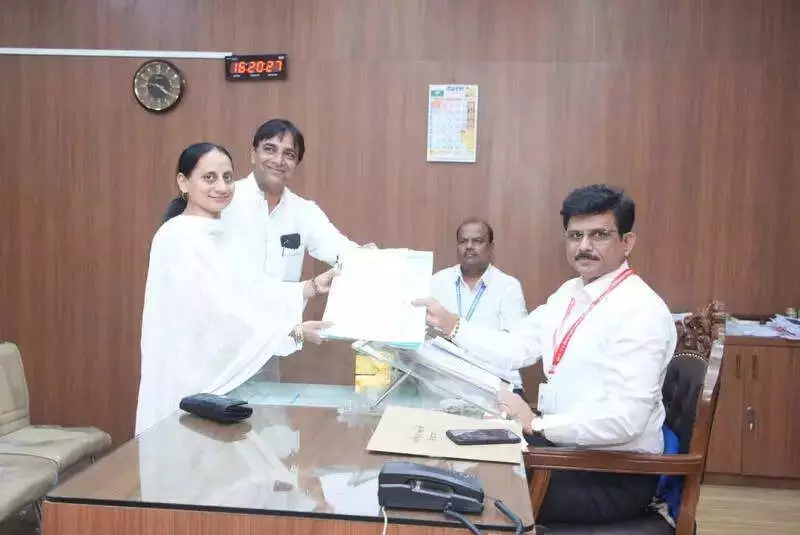
In the upcoming Brihanmumbai Municipal Corporation (BMC) elections, a recurring trend is emerging across several wards newly reserved for women candidates. Instead of bringing fresh faces into the political arena, the reservation has led to seasoned politicians fielding their wives, ensuring that electoral power remains firmly within established family networks.
The Nagpada Blueprint: From Husband to Wife
Take the case of Ward 213 in Nagpada. Former Congress corporator Javed Juneja, who first entered the BMC house in 2012 and successfully defended his seat in the 2017 municipal polls, is sitting out this election because the ward is now reserved for a woman. Stepping into his place is his wife, Naseema Juneja.
Defending the decision, Javed Juneja stated that since the ward was reserved for a woman candidate, they decided to field her. He expressed confidence in her victory, citing his own long-standing work in the area as a foundation for her campaign.

A Pattern Repeats Across Parties and Wards
This is not an isolated incident. A similar handover is occurring in Ward 72, where the Bharatiya Janata Party (BJP) has fielded Mamta Yadav. Her husband, Pankaj Yadav, won this seat for the first time in the 2017 civic elections. With the ward now reserved for women, he has passed the baton to his wife.
Pankaj Yadav justified the candidature by highlighting his wife's active involvement in ward-level work for years. He noted her role as the ward's vice-president, her leadership in Women's Day celebrations, and her recent work linking beneficiaries to the Laadli Bahin scheme. He also mentioned her postgraduate degree and her partnership in their family-run coaching classes.
In Ward 84, former BJP corporator Abhijit Samant has secured a party ticket for his wife, Anjali Samant, for the seat he represented in 2017. Samant argued that his wife has been integral to his political journey from day one, participating in social initiatives from distributing rain footwear to organizing Diwali celebrations. He claimed she is a familiar face in the ward, making her candidacy a logical choice.
Reservation or Reinforcement of Dynasties?
Political observers point out that such candidatures reveal a critical flaw in the implementation of women's reservation. While the policy aims to expand female representation on paper, it often ends up reinforcing entrenched political families.
This trend raises significant questions about whether the reservation truly widens access for new women leaders or merely reshuffles power within existing political households, allowing male politicians to retain influence through proxy candidates.
The upcoming BMC polls in Mumbai thus present a paradox: seats reserved for women are being contested, but the candidates frequently carry familiar political surnames, suggesting that the gatekeepers of local political power remain unchanged.






