

Ahmedabad's Cycling Crisis: A Tale of Neglect and Wasted Funds
Cycling on the roads of Ahmedabad is an exercise fraught with significant risks, primarily due to unruly traffic, congested thoroughfares, and a severe lack of dedicated lanes for bicyclists. Even where cycling tracks exist, they are often rendered unusable by rampant encroachments, damage from vehicles, or sheer neglect, forcing cyclists to brave the main roads alongside fast-moving traffic. This hazardous situation has led to numerous injuries and fatalities over the years, highlighting a critical public safety issue in the city.
Election Promises and Failed Implementations
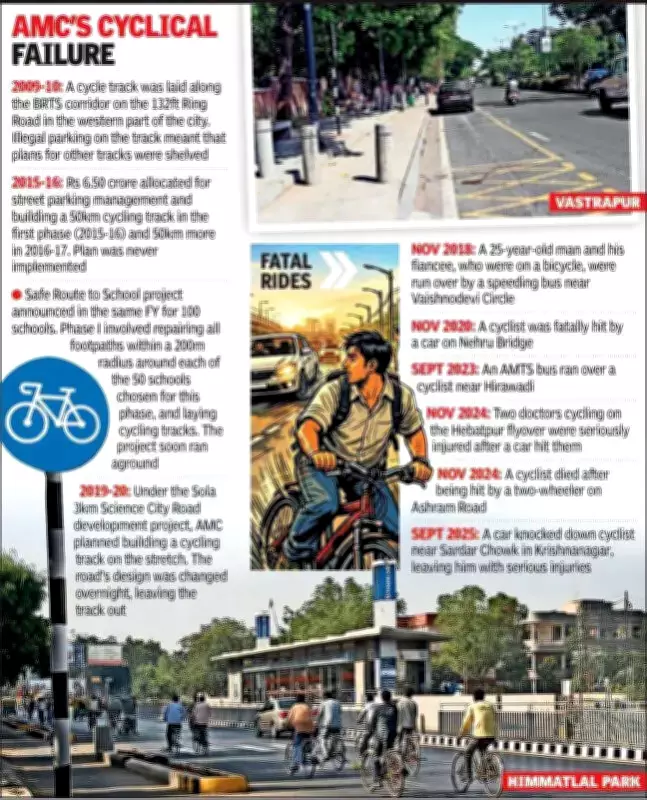
As Ahmedabad Municipal Corporation (AMC) enters an election year, the perennial promise of laying dedicated cycling tracks is once again under scrutiny. Experts point out that after two decades and the allocation of crores of rupees, elected representatives have consistently failed to establish uninterrupted cycling infrastructure. This failure not only deprives residents of a basic amenity but also stalls a green step towards environmental sustainability, as cycling could significantly reduce air pollution in the city.
AMC officials have cited central government initiatives, such as the Amrut and Smart City schemes, which promoted cycling to combat air pollution and provided funds for infrastructure development. In 2019, under the Amrut scheme, the civic body approved a Rs 22.7-crore project to develop cycling tracks on specific stretches, including from Keshavbaug Party Plot to Pakwan Crossroads, Judges Bunglow Crossroads to NIFD Circle, and Sanjivani Hospital in Vastrapur to the gurdwara on SG Highway.

Short-Lived Success and Costly Failures
The tracks from Judges Bunglow Crossroads to NIFD Circle and from Sanjivani Hospital to the gurdwara were completed at a cost of Rs 5.50 crore. However, this positive development for cyclists was short-lived. The newly built tracks quickly turned into parking areas, with AMC failing to enforce regulations against vehicle owners. Instead of addressing this misuse, the civic body shelved plans for the remaining stretch under the project. Consequently, no additional tracks were built, and Rs 5.50 crore of taxpayers' money was effectively wasted.
An anonymous AMC official revealed that the remaining central grant did not materialize, further stalling progress. In April 2023, the issue of encroachments on cycling tracks in the city's east and west was discussed at AMC's standing committee meeting. Rather than rectifying the problem, the committee decided to remove entire stretches of cycling tracks along BRTS corridors and newly built ones in areas like Anandnagar, Prahladnagar, and Bodakdev.
Deteriorating Infrastructure and Lack of Planning
This decision has placed Ahmedabad among Indian cities with the lowest proportions of functional cycling infrastructure. A senior AMC official noted that today, less than 5 kilometers of cycling lanes remain usable, with existing infrastructure either deteriorated or vanished entirely. Experts criticize AMC for never adopting a practical approach to cycle tracks, which has largely discouraged cyclists from using them due to safety concerns and inconvenience.
Compounding the issue, AMC's Rs 405-crore Iconic Roads project for seven stretches does not include any planning for cycling tracks. Similarly, the Rs 334-crore precinct area development project covering four roads also neglects this essential infrastructure. This oversight reflects a broader pattern of inadequate urban planning that prioritizes vehicular traffic over sustainable and safe alternatives like cycling.
As Ahmedabad grapples with growing traffic congestion and pollution, the failure to develop and maintain cycling infrastructure represents a missed opportunity for promoting healthier lifestyles and environmental conservation. The ongoing neglect raises questions about the city's commitment to green initiatives and public welfare, especially as election cycles bring renewed but often unfulfilled promises.






