Five years have passed since the tragic Shrey Hospital fire in Ahmedabad. That disaster claimed eight lives and forced the Ahmedabad Municipal Corporation to issue strict fire-safety advisories. A key recommendation was clear: keep Intensive Care Units on the ground floor whenever possible. This rule aimed to minimize fire risks and ensure swift patient evacuation.
A Striking Contradiction Emerges
Today, the AMC finds itself on the wrong side of its own regulations. Its newly constructed, Rs 185-crore LG Hospital building in Maninagar presents a glaring contradiction. The facility houses its Respiratory ICU and Burns Ward on the ninth floor. This placement directly opposes the corporation's earlier directives to private hospitals.
The Shadow of the 2020 Tragedy
The contradiction traces back to August 2020. A fire broke out in an ICU at Shrey Hospital in Navrangpura. Eight patients lost their lives. The tragedy triggered intense scrutiny of fire safety protocols across private hospitals in the city.

Following expert advice from its own fire and health departments, the AMC urged hospitals to locate ICUs on the ground floor. The matter even reached the Gujarat High Court. The court issued directions for strict compliance with fire-safety norms.
Acting on a court order related to a Public Interest Litigation, the then Chief Fire Officer of Ahmedabad wrote to over 200 private hospitals in June 2022. The letter mandated undertakings based on a detailed 10-point safety checklist.
A crucial clause in that checklist stated: "ICU should preferably be located only on the ground floor and have alternate exits wide enough to roll beds out in an emergency."
Private Hospitals Comply, But AMC's Own Project Deviates
While private hospitals were compelled to file undertakings and adhere to these rules, the AMC's own flagship civic hospital appears to have taken a different path. The new LG Hospital is a massive 795-bed facility with a built-up area of nearly 59,571 square metres. It features 14 operation theatres.
Official records reveal an interesting shift in planning. The initial layout for the new building placed ICUs, the Burns Ward, the RICU, and operation theatres on the third floor. A lecture hall was proposed for the ninth floor.
Plan Altered During Construction
However, the plan changed during construction. The Medical Council revised its guidelines. It stated that a lecture hall was not mandatory if the medical college and hospital shared the same campus. Seizing this opportunity, the AMC scrapped the lecture hall plan.
Instead, it decided to relocate the Burns Ward and the Respiratory ICU to the vacant ninth floor. The AMC's standing committee approved these revisions to the plan. It also sanctioned a cost escalation of Rs 3.69 crore. This approval took the total project cost from an initial tender of Rs 182 crore to Rs 185 crore. The project replaces an old two-storey structure.
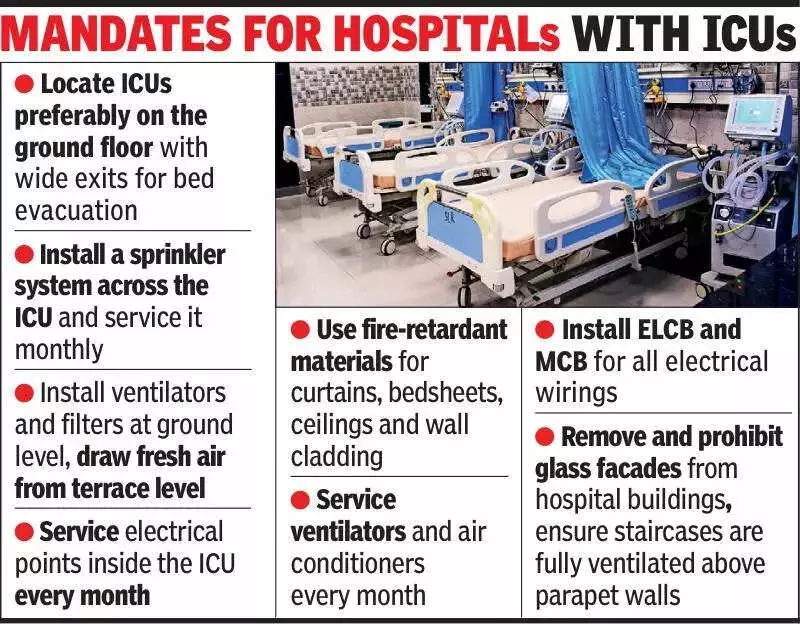
Key Fire Safety Requirements for Hospitals with ICUs
The AMC's own checklist for hospitals highlights critical safety measures. These requirements were emphasized after the Shrey Hospital fire. They include:
- Locate ICUs preferably on the ground floor with wide alternate exits for bed evacuation.
- Install a comprehensive sprinkler system across the ICU and service it every month.
- Use fire-retardant materials for curtains, bedsheets, ceilings, and wall cladding.
- Conduct monthly servicing of all electrical points inside the ICU.
- Install and regularly service ventilators and air conditioning units.
- Ensure proper electrical safety with ELCB and MCB for all wiring.
- Avoid glass facades in hospital buildings and ensure staircases are fully ventilated.
The situation raises serious questions about consistency in enforcing fire safety standards. The very body that created the rules for others now seems to have bypassed them in its own major infrastructure project. This discrepancy highlights a significant gap between policy formulation and implementation, even within the civic administration itself.