

Ahmedabad's Electric Bus Ambitions Face Reality Check as Walking Emerges as Primary Commute Mode
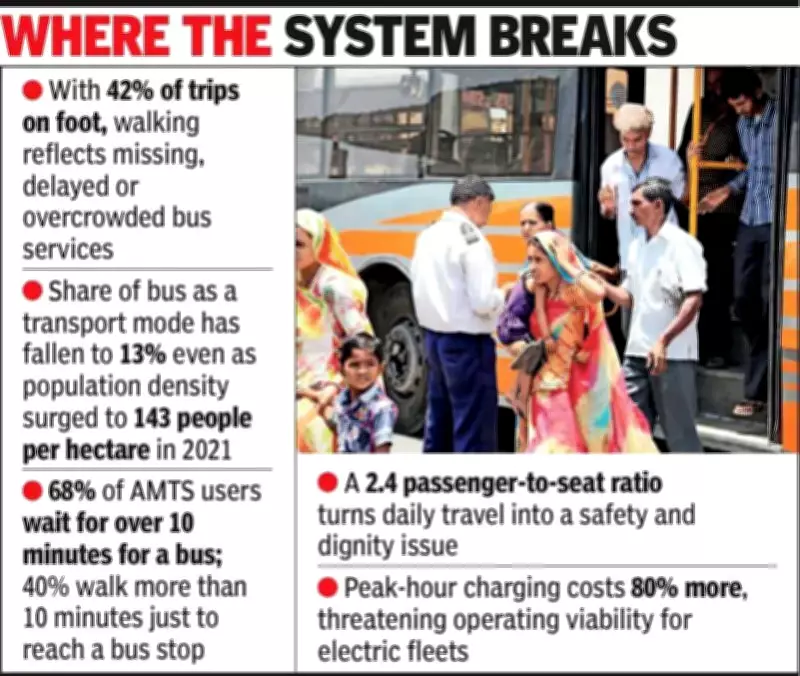
A comprehensive new study has exposed significant challenges in Ahmedabad's public transportation system, even as the city pursues ambitious green mobility goals. The research reveals that in a metropolitan area with approximately 8.5 million residents, a staggering 42% of all daily trips are completed on foot. This finding highlights the critical role of pedestrian movement in urban mobility, often overlooked in transportation planning.
Sharp Decline in Bus Ridership Despite Urban Expansion
The study, conducted by researchers Upendra Kumar and Ram Krishna Upadhyay from the School of Technology at Gati Shakti Vishwavidyalaya in Vadodara, presents troubling data about bus transportation. Bus services accounted for merely 13% of motorized journeys in 2025, representing a dramatic decline from 25% in 2012. This reduction occurred despite Ahmedabad's built-up area expanding by 60% between 2011 and 2021, indicating that public transportation infrastructure failed to keep pace with urban growth.
Service frequency has emerged as a major concern, with nearly 80% of bus routes operating with headways exceeding 20 minutes between vehicles. This unreliable service has pushed commuters toward alternative transportation methods, particularly two-wheelers, which now dominate the motorized mode share at 52%. The shift represents a significant setback for sustainable urban mobility initiatives.

Electric Bus Expansion Plans Confront Operational Realities
Ahmedabad Municipal Transport Service (AMTS) currently operates or has under procurement 999 electric buses, with plans to scale the fleet to 3,000 by 2030 as part of the city's green transportation push. However, the study identifies substantial financial and operational hurdles that could undermine these ambitions.
The transport service recovers only 30% of its operating costs, one of the lowest ratios observed across India's public transportation systems. This financial strain is compounded by severe overcrowding, with buses operating at a passenger-to-seat ratio of 2.4. Researchers describe this level of congestion as requiring immediate fleet expansion, yet they caution that even additional vehicles cannot be effectively integrated without systemic improvements.
Infrastructure and Gender Disparities Complicate Transition
Power infrastructure presents another significant challenge for the electric bus transition. Fast-charging during peak hours costs approximately Rs 9 per kilowatt-hour, compared to Rs 5 during off-peak periods. This cost differential creates operational complexities for maintaining consistent service while managing expenses.
The study emphasizes that "without comprehensive route redesign, frequency upgrades, and better integration with the Bus Rapid Transit System (BRTS), electrification risks becoming a costly overlay on a system that remains fundamentally inadequate." This warning suggests that technological upgrades alone cannot solve deeper structural problems in Ahmedabad's transportation network.
Gender disparities in transportation usage further complicate the picture. Women account for 44% of their motorized trips via public or intermediate transport, compared to 32% for men. Despite this higher reliance on public options, overcrowding and poor service quality force many women to walk long distances, potentially compromising safety and convenience.
The research underscores the need for a holistic approach to urban mobility that addresses infrastructure, service quality, financial sustainability, and social equity simultaneously. As Ahmedabad moves forward with its electric bus expansion, these findings suggest that success will require more than just vehicle procurement—it demands a fundamental rethinking of how the city moves its residents efficiently and equitably.






