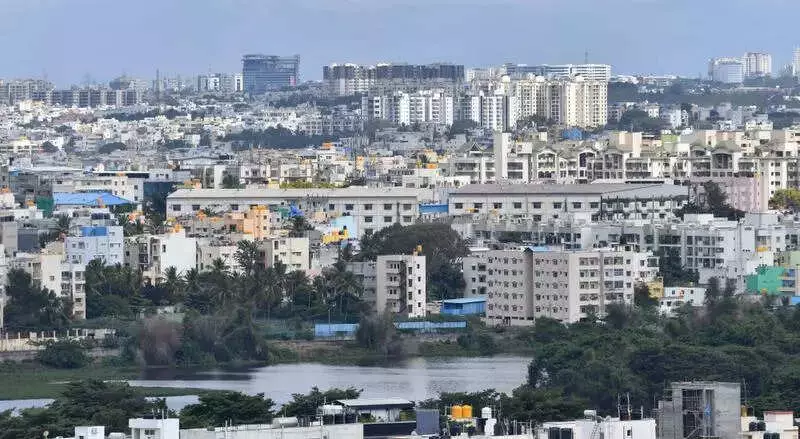
In a significant development for India's tech capital, four of the five newly formed city corporations in Bengaluru have submitted their first independent budgets to the state government. This marks a pivotal shift towards decentralized urban governance, with the civic bodies meticulously mapping their financial requirements and prioritizing development initiatives for the upcoming fiscal year.
Financial Demands and State Reliance
The budgetary submissions reveal substantial financial demands from the newly established corporations. The Bengaluru Central city corporation has sought the highest grant of Rs 2,047 crore, followed closely by the East corporation with Rs 1,685 crore, the South corporation with Rs 1,675 crore, and the North corporation with Rs 1,210 crore. Cumulatively, these four corporations have requested over Rs 6,600 crore from the state government, clearly indicating their heavy reliance on state support during these initial formative years.
The West city corporation is anticipated to place a similar financial demand as its budgeting process gains momentum. It is important to note that these corporations will formally table their budgets only after the state government presents its own budget, creating a sequential financial planning process.

Decentralized Governance and Citizen Participation
Maheshwar Rao, Chief Commissioner of the Greater Bengaluru Authority (GBA), emphasized that this budgetary exercise represents a fundamental shift towards decentralized urban governance. "The budgetary exercise is being positioned as a shift towards decentralised urban governance," Rao stated, highlighting the transformative nature of this administrative restructuring.
In preparation for their inaugural independent budgets, all five corporations actively engaged with citizens, resident welfare associations, and various organizations to gather suggestions before framing their 2026–27 financial plans. Officials involved in the process confirmed that the focus remains on identifying local priorities across critical areas including infrastructure development, public health initiatives, safety measures, environmental protection, and social welfare programs.
Corporation-Specific Development Focus
Each corporation has outlined distinct development priorities aligned with their jurisdictional needs:
Central Corporation: Rajendra Cholan, Commissioner of the Central corporation, revealed that their primary focus centers on developing basic infrastructure in and around the central business district, with approximately Rs 500 crore proposed for this purpose. "Our primary focus is the development of basic infrastructure in and around the central business district, for which about Rs 500 crore is proposed to be earmarked," Cholan explained. An additional Rs 200 crore is allocated for slum infrastructure development, while the remaining funds target solid waste management, lake rejuvenation, and horticultural projects.
North Corporation: Pommala Sunil Kumar, Commissioner of the North corporation, highlighted two major financial requirements: Rs 500 crore for extensive drain works and another Rs 500 crore for constructing new roads. Notably, the corporation has identified a special need of Rs 25 crore for stray dog relocation, addressing the significant canine population within their jurisdiction.
South Corporation: Development priorities in the South corporation concentrate on parks, road networks, and comprehensive waste management systems, reflecting the area's specific urban challenges.
Historical Context and Future Expectations
The previous year saw the Bruhat Bengaluru Mahanagara Palike (BBMP), GBA's predecessor, present a budget of Rs 19,930 crore, later revised to Rs 20,440 crore. The state government released substantial grants that facilitated large-scale projects including tunnel roads, white-topping initiatives, elevated corridors, flyovers, and stormwater drain development. A dedicated agency named B-Smile was established to oversee the implementation and maintenance of these mega projects.

Rao further elaborated that the upcoming budgets of the five city corporations are expected to clearly delineate whether and how funds will be allocated for such large-scale infrastructure works and solid waste management initiatives. Another GBA official disclosed that from BBMP's existing funds, a total of Rs 613.6 crore has already been distributed among the five corporations, providing them with an initial financial cushion as they embark on their first independent budget exercises.
Financial Management Directives
The GBA has directed all corporations to strengthen their collection mechanisms for property tax and other statutory dues. Each corporation must allocate sufficient funds for staff salaries, administrative expenses, and development works, ensuring balanced financial management as they establish their independent operational frameworks.
This budgetary transition represents a crucial phase in Bengaluru's urban administration, with the new corporations navigating the complexities of financial autonomy while addressing the city's pressing development needs through structured, citizen-informed planning processes.