Bengaluru Reports Significant Decline in Garbage Blackspots Over Six Months
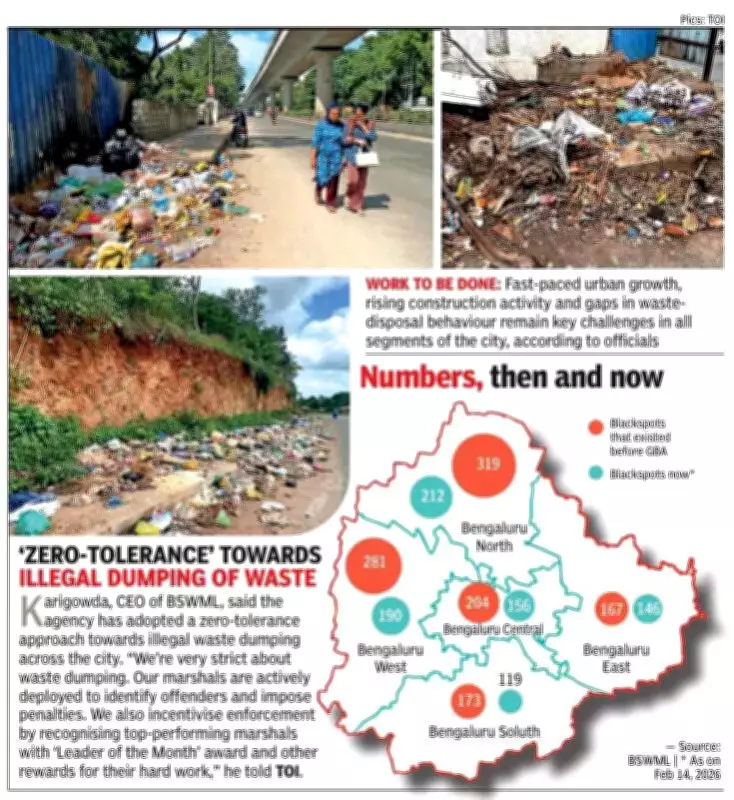
According to data released by Bengaluru Solid Waste Management Limited (BSWML), the city has witnessed a notable 28% reduction in garbage blackspots in the past six months. The number of such sites dropped from 1,144 in September 2025 to 823 in February 2026, reflecting sustained efforts in solid waste management across multiple city corporations.
Officials attribute this decline to targeted interventions, though the pace and nature of action have varied significantly across different regions of Bengaluru. While some zones achieved sharper corrections through enforcement and coordinated clean-up drives, others focused on infrastructure-led responses to tackle persistent waste accumulation.
Regional Progress and Challenges in Waste Management
West and South Bengaluru Lead in Blackspot Reduction

In Bengaluru West city corporation's jurisdiction, blackspots declined sharply from 281 to 190. Localities such as Rajajinagar, Vijayanagar, and Basavanagudi saw sustained clearance of chronic dumping points. This improvement was aided by tighter surveillance, improved door-to-door waste collection, and stronger ward-level enforcement to prevent fresh accumulation.
Similarly, Bengaluru South city corporation recorded notable progress, bringing the blackspot count down from 173 to 119. Areas like Jayanagar, Padmanabhanagar, and BTM Layout reported visible improvements following focused clean-up drives, closer supervision by ward officials, and continuous monitoring mechanisms aimed at curbing re-dumping.
Central and North Bengaluru Focus on Monitoring and Infrastructure
In contrast, Bengaluru East city corporation registered only a marginal drop in numbers, from 167 to 146—the lowest improvement across the city's civic jurisdictions. Rapidly expanding areas like KR Pura and Mahadevapura continued to account for a significant number of illegal dumping sites, highlighting the pressures of fast-paced urbanisation, construction debris generation, and inconsistent waste segregation practices.
Bengaluru Central city corporation concentrated on institutionalising monitoring mechanisms aligned with Swachh Survekshan standards. Civic authorities trained field teams on evaluation criteria and compliance benchmarks, while appointing a deputy general manager and a dedicated nodal officer to track garbage blackspot removal and toilet maintenance. The corporation also intensified constituency-level drives twice a month.
Daljeet Kumar, additional commissioner of Bengaluru Central corporation, stated, "We provided training on all criteria used in Swachh Survekshan and appointed a DGM and nodal person to monitor blackspot removals and toilet cleaning. We conduct intensive cleaning every second and third Fridays, ensuring complete cleaning with forest, horticulture, and BSWML teams, alongside continuous monitoring."
In Bengaluru North city corporation limits, the challenge was more infrastructure-driven, with 319 solid waste-dumping locations identified. Weekly ward-level cleanliness drives are underway, involving resident welfare associations and non-governmental organisations in beautification efforts to prevent fresh dumping.
Bengaluru North commissioner Pommala Sunil Kumar explained, "We operate 19 functional dry waste collection centres with a combined capacity of 55 tonnes per day, four mini-transfer stations of 30 TPD each, and one large transfer station in Sarvagnanagar. A 5-TPD biomethanation plant at HRBR Layout is ready but not yet operational. We also conducted 'Mission Clean Airport Road' covering 34km, mega drives across 128.3km clearing 599 tonnes of waste, and intensive Outer Ring Road cleaning, removing 1,200 tonnes while clearing encroachments. Out of 319 dumping sites, 107 were cleared."
The North corporation has additionally launched a weekly "phone-in" grievance programme, receiving 184 complaints and resolving 180 so far, signalling an attempt to close feedback loops alongside physical clean-up drives.

Ongoing Challenges and Future Outlook
Despite the progress in clearing illegal dumping points, 823 blackspots remain across Bengaluru. Rapid urban growth, construction activity, and behavioural gaps in waste disposal continue to pose significant challenges. Officials emphasise that sustained efforts and community participation are crucial to further reducing garbage blackspots and enhancing the city's overall cleanliness.
The data underscores the importance of tailored strategies for different zones, combining enforcement, infrastructure development, and public engagement to achieve long-term waste management goals in India's tech capital.