

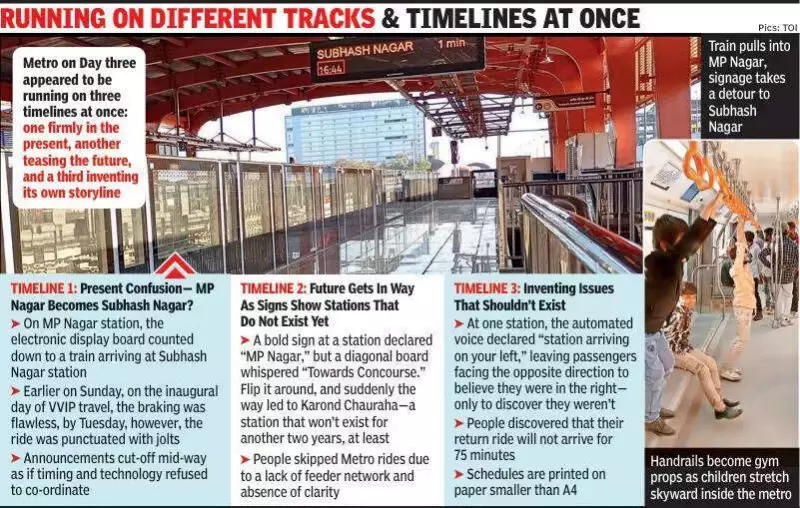
The promise of a sleek, modern metro system in Bhopal met the stark reality of operational hiccups on just its third day of commercial service. Passengers at the MP Nagar metro station, eager to capture the arrival of the new train, were instead greeted by an electronic display board seemingly lost in another dimension, highlighting the teething troubles of the nascent network.
A Journey Through Confusing Signage and Timelines
As commuters lifted their phones, the display countdown was not for a train arriving at MP Nagar, but for one at Subhash Nagar station. This disorienting start set the tone for a commute that felt like navigating multiple timelines. For disembarking passengers, it created phantom stops and anxieties about incorrect alighting.
The confusion multiplied on the staircases. While a bold sign correctly pointed to "MP Nagar," a diagonal board contradicted by indicating "Towards Concourse." Flipping this board around revealed directions to Karond Chauraha—a station not slated to open for at least another two years. This signage chaos made the envisioned digital utopia of driverless trains and QR-code ticketing feel like a distant mirage.

Technical Glitches and Passenger Adaptations
The ride experience itself was inconsistent. Compared to the flawless braking during the VVIP travel day on Sunday, Tuesday's journeys were punctuated by jolts, almost a tactile warning against moving for selfies. Undeterred, some young passengers turned the coach handholds into gym props. Inside, technology faltered; at KV station, the "Stand away from the gates, gates closing" announcement cut off mid-sentence, while at other stops, the automated voice declaring "station arriving on your left" misled passengers facing the opposite direction.
In the absence of reliable digital displays, commuters were forced to rely on printed paper schedules smaller than an A4 sheet. Businessman Chandrakant and his wife, boarding at AIIMS Bhopal, discovered their return train was 75 minutes away. After squinting at the tiny timetable, they opted for a cab, with Chandrakant concluding they would reach faster that way. Others, like Sarfaraz and his wife, played safe by clutching return tickets and remaining seated, only to find even security guards fumbling with multiple ticket slips, unsure which to tear.
Orderly Platforms Amidst Operational Chaos
Despite the confusion, a strange order prevailed on the platforms. At MP Nagar, before the three-coach train arrived, about 15 people waited under the watch of two security staff. A barrier systematically held back boarding passengers until those exiting had cleared—a choreographed order starkly different from the platform chaos typical of metros in Delhi or Mumbai.
Stepping out of the station underscored the contrast: inside was a glimpse of a promised high-tech future; outside, the ground reality of dust and disorder remained. The Bhopal Metro's early days reveal a system caught between its ambitious digital blueprint and the practical challenges of a real-world rollout, leaving passengers to bridge the gap with patience, guesswork, and occasionally, a booked cab.






