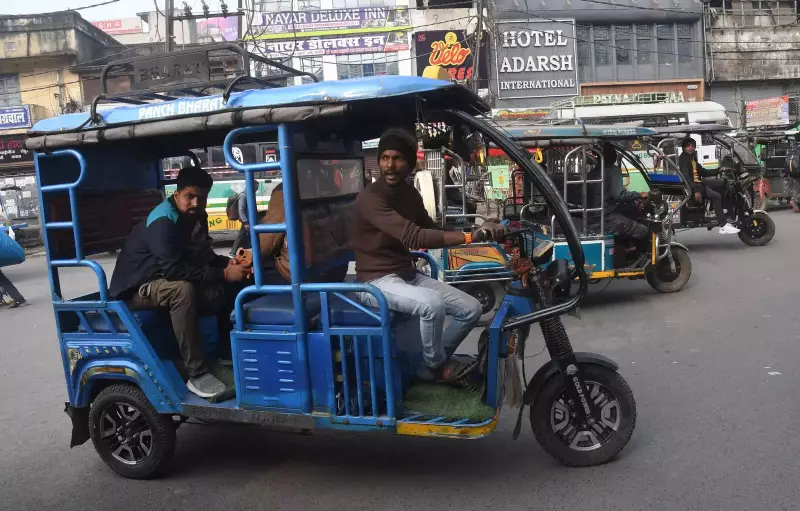
Bihar Government Implements Ban on E-Rickshaws Across Highways
The Bihar government has issued a strict order prohibiting e-rickshaws from plying on national and state highways throughout the state. District transport officers must enforce this restriction immediately.
Scope of the Ban and Key Routes Affected
According to the transport department, the ban covers approximately 10,000 kilometers of highways in Bihar. This includes 3,617 kilometers of state highways and 6,389 kilometers of national highways.
In Patna, authorities will enforce the ban on major arterial roads. These routes include the New Bypass, Bihta-Sarmera Road, Patna-Gaya Road, and the Phulwarisharif-Danapur-Bihta road.

Safety Rationale Behind the Decision
Transport Minister Shravan Kumar explained the government's reasoning. He stated that e-rickshaws pose significant safety risks on highways designed for high-speed traffic. Highways primarily accommodate vehicles like trucks, buses, and cars.
The presence of slow-moving e-rickshaws increases accident risks substantially. Kumar emphasized that e-rickshaws lack strong braking systems to handle sudden stops or sharp turns at high speeds. This deficiency threatens both passengers and other road users.
The official order notes that the low speed of e-rickshaws makes them vulnerable on highways. This vulnerability can lead to damage to lives and property.
Additional Ban on Jugaad Vehicles
Alongside e-rickshaws, the government has decided to impose a complete ban on jugaad vehicles. These vehicles are often assembled from scrap materials like motorcycle engines and wooden planks. They are commonly used in rural areas to transport people and goods.
Officials stated that jugaad vehicles operate without proper registration, fitness certificates, or insurance. This operation directly violates the Motor Vehicles Act. Such vehicles fail to meet prescribed technical or safety standards, multiplying accident risks.
Brake systems in these vehicles are unreliable. Essential safety features like lights and indicators are usually missing.
Widespread Concern Among Operators and Passengers
While the government defends the decision on safety grounds, the ban has triggered widespread concern. E-rickshaw operators and passengers in rural and semi-urban areas are particularly worried. These vehicles serve as a vital mode of transport in these regions.
The restriction is expected to affect thousands of drivers who depend on e-rickshaws for their daily income. Many drivers said they were already struggling due to strict enforcement drives in recent months. They fear the new order will further erode their livelihoods.
Criticism from the E-Rickshaw Drivers' Association
Himanshu Kumar, general secretary of the E-rickshaw Drivers' Association, criticized the decision. He called it politically motivated.
"The decision is completely politically motivated. Other associations related to auto-rickshaws and cabs want the plying of e-rickshaws to be completely banned on the road," he said.
Kumar noted that around 18,000 to 20,000 e-rickshaws operate in Patna district. The decision would affect approximately 8,000 of them. More than 3 lakh e-rickshaws operate across the entire state.
Passenger Concerns Over Daily Mobility
Passengers also expressed concern about the ban's impact on daily mobility. Rajesh Gupta, a resident of the Kankarbagh area, highlighted potential difficulties. He said people living along bypass stretches would face serious challenges because auto-rickshaws do not operate inside many residential localities.
Ramesh Sinha, a resident of Naubatpur, emphasized the affordability of e-rickshaws. "E-rickshaws are a cheaper medium of transport for lower-income groups. If we have to reach Bairiya bus stand or Patna Junction with family and luggage, then hiring an e-rickshaw is cheaper than autos," he explained.
Future Implications for Commuters and Drivers
With highways now closed to e-rickshaws, commuters fear they will be forced to depend on costlier or less convenient transport options. Drivers worry about losing access to key routes that sustain their earnings. The ban raises significant questions about balancing safety with affordable transportation in Bihar.