

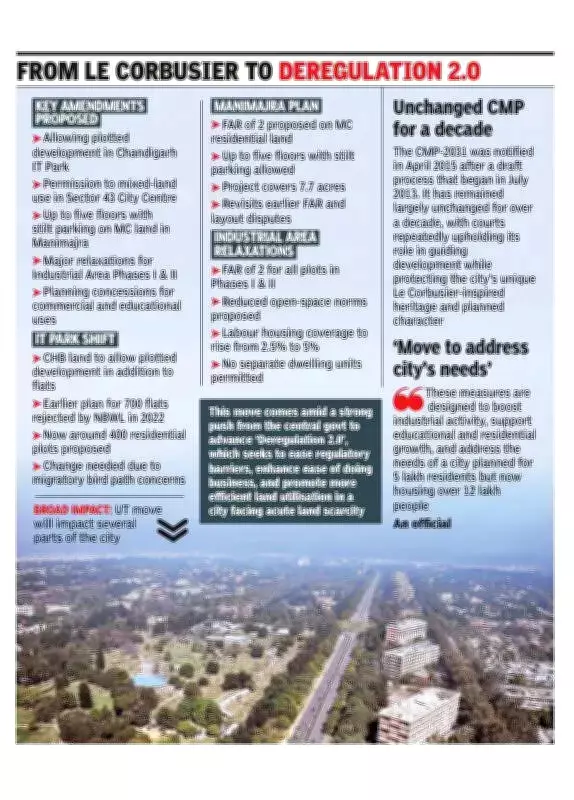
Chandigarh Administration Finalizes Transformative Master Plan Amendments
In a landmark urban planning decision, the Chandigarh administration has approved significant amendments to the city's master plan, marking one of the most substantial shifts in development policy over the past decade. These changes are set to revolutionize land use regulations, building norms, and development controls across critical zones, addressing the city's rapid population growth and acute land scarcity.
Key Proposals and Regulatory Changes
The proposed amendments, which will be submitted to the Ministry of Home Affairs (MHA) for final approval, include several transformative measures:
- Plotted Development in IT Park: The Chandigarh IT Park will now permit plotted development alongside existing flat constructions, unlocking large tracts of land under the Chandigarh Housing Board (CHB).
- Mixed-Land Use in Sector 43 City Centre: The Sector 43 City Centre will allow mixed-land use, promoting integrated commercial and residential spaces.
- Enhanced Building Norms in Manimajra: Municipal corporation land in Manimajra will permit up to five floors with stilt parking, with a proposed floor area ratio (FAR) of 2, covering a 7.7-acre plot.
- Relaxations for Industrial Areas: Industrial Area Phases I and II will see major relaxations, including a FAR of 2 for all plot categories, reduced open-space norms, and increased labor housing coverage from 2.5% to 5%.
- Planning Concessions: Additional concessions for commercial establishments and educational institutions are part of the comprehensive overhaul.
Background and Environmental Considerations
The push for these amendments aligns with the central government's "Deregulation 2.0" initiative, aimed at easing regulatory barriers, enhancing ease of doing business, and optimizing land utilization. This move comes as Chandigarh, originally planned for 500,000 residents, now grapples with a population exceeding 1.2 million and heavy reliance on rental housing.

Officials highlighted that the CHB's previous plan to construct 700 flats on 16.6 acres in the IT Park was rejected by the National Board of Wildlife (NBW) in 2022 due to environmental concerns. The NBW cited the project's location in a migratory bird path and potential adverse effects from waste, noise, and air pollution on nearby sanctuaries. As a result, the new proposal shifts to approximately 400 residential plots, requiring master plan changes to accommodate this development.
Public Consultation and Approval Process
According to administration officials, a draft proposal for the amendments will first be made available for public scrutiny. Stakeholders, residents, and the general public will have the opportunity to review the changes, submit suggestions, and raise objections. The proposal will also undergo evaluation by a select committee of experts before being forwarded to the MHA for final approval.
"The draft proposal will be put in the public domain after receiving the nod from the competent authority," stated a senior UT official, emphasizing the transparent and participatory nature of the process.
Historical Context and Future Implications
The Chandigarh Master Plan-2031 was notified in April 2015, following a draft process that began in July 2013. It has remained largely unchanged for over a decade, with courts consistently upholding its role in guiding development while preserving the city's unique Le Corbusier-inspired heritage and planned character.
"These measures are designed to boost industrial activity, support educational and residential development, and unlock stalled projects in a city facing rapid population growth and acute land scarcity," explained an official. The amendments aim to foster sustainable urban growth, address housing shortages, and promote economic vitality in Chandigarh.






