

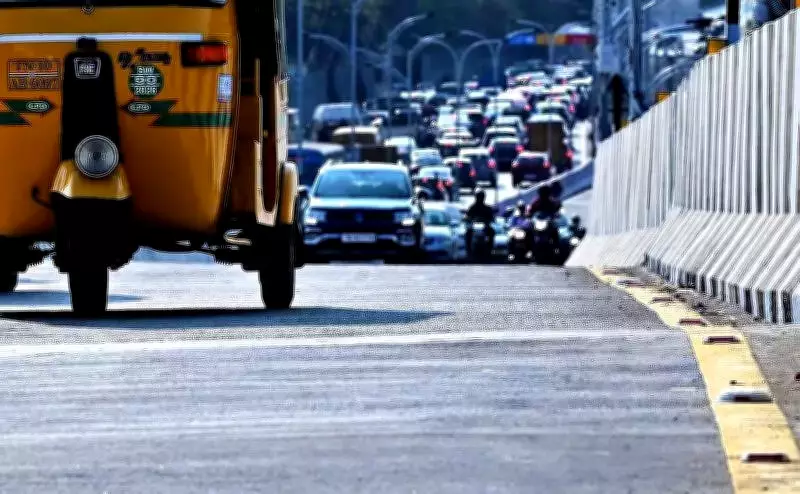
Chennai's New Madhya Kailash Flyover Faces Bumpy Ride Complaints After Inauguration
Just days after Chief Minister M K Stalin inaugurated the 60-crore Madhya Kailash flyover in Chennai, commuters are reporting an unexpectedly bumpy ride on the 652-meter-long structure. The flyover, unveiled last week to ease traffic from Sardar Patel Road to OMR, has seen videos of the rough journey go viral, sparking concerns among residents and experts alike.
Details of the Bumpy Experience
While the first 80 meters from Sardar Patel Road, where highways laid a bituminous macadam approach road, offered a smooth passage, the remaining stretch constructed in concrete is filled with noticeable undulations. This inconsistency has led to widespread complaints, with many questioning the quality and safety of the infrastructure project.
Expert Analysis and Potential Causes
Sampath Kumar, a highways and transportation professor at Sathyabama University, suggests that the steel bearings supporting the flyover may be deflecting more than anticipated. He explains, "The flyover is supported by steel reinforcements, pulled and tied by steel wiring. These reinforcements typically deflect to a certain degree under load, with calculations made during load tests to ensure adequate reinforcement. If errors occurred in testing readings, the reinforcements could deflect excessively, causing a bumpy ride and potentially making the structure unsafe over time, as cracks may emerge from beneath."

Kumar adds that load tests are usually conducted with multi-axle trucks in the central part of the flyover to assess deflections, raising questions about why bumps are felt even by smaller vehicles like cars and bikes.
Another factor could be the use of poor-grade concrete. Kumar notes, "In Tamil Nadu, they often use M40 grade concrete, which has a finer mix of granules. However, M50 concrete is generally recommended for such projects, and in some metro corridors in Delhi, they use M90 concrete. The higher the grade, the more rigid and durable the structure becomes."
R Ramarao, a highways contractor with over three decades of experience and president of the Greater Chennai Contractor Association, points to poor levelling of concrete as a possible cause. He states, "Uneven bumps can result from inadequate levelling or uneven elevation between expansion joints. Even a minor 10-mm elevation difference can feel bumpy. Remedying this would require removing and relaying the concrete, but that's nearly impossible now that the flyover is open to traffic."
Official Response and Safety Assurances
Highways chief engineer Jawahar Muthuraj and superintending engineer Rajadurai were unavailable for immediate comment, citing meetings. However, another official associated with the project acknowledged the complaints, stating, "We will look into the issues. While an asphalt road typically offers better flatness compared to concrete, the flyover is structurally safe. The bumps may normalize in the concrete over time as it settles."
Despite these assurances, the situation has ignited a debate on infrastructure quality and public safety in Chennai, with calls for a thorough investigation to address the underlying problems and ensure long-term reliability.






