

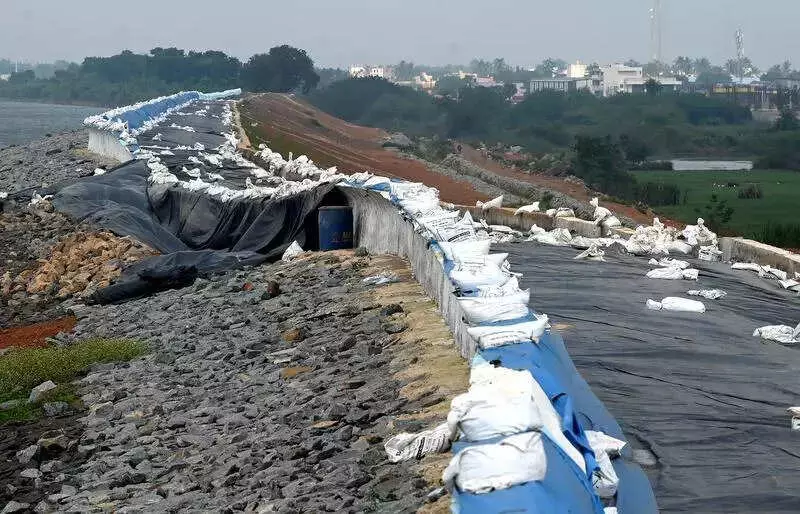
Heavy monsoon showers have once again exposed the structural vulnerabilities of one of Chennai's key drinking water sources. A portion of the recently constructed bund at the historic Cholavaram reservoir in Tiruvallur district has suffered significant damage, prompting emergency measures from authorities.
Immediate Response and Root Cause
In response to the breach, the Water Resources Department (WRD) swiftly covered the affected stretch with heavy-duty tarpaulin sheets. This action aims to prevent further erosion and soil loss from the earthen embankment. Officials have pinpointed the cause to continuous seepage combined with intense pressure from rapidly rising water levels within the reservoir.
C Podupanithilagam, the Chief Engineer of WRD for the Chennai region, clarified the situation. "Rain-related cracks and soil erosion gullies that developed on the downstream slope are being rectified by the contractor at their own cost during the defect liability period," he stated. This highlights that the repair work falls under the contractor's obligation for recently completed work.

A History of Structural Weakness
This incident is not an isolated one. The Cholavaram reservoir, originally built in 1891, has a long-standing history of such vulnerabilities that resurface almost every monsoon season. The core issue lies in the geological characteristics of the area and the quality of the soil used in the bund's initial construction over a century ago, making it inherently prone to slips and cracks.
To meet growing demand, the bund's height has been increased multiple times since 1970, from its original 18.33 meters to 19.96 meters. This expansion boosted its storage capacity to 108 million cubic feet (mcf). However, these modifications have also added stress to the aged structure.
Temporary Fix vs. Permanent Solution
Current repairs, as in the past, are temporary. The damaged sections have been levelled using cement-bonded concrete blocks before being shrouded in tarpaulin. For a lasting remedy, a major rehabilitation project is finally in motion.
"To provide a permanent solution, a comprehensive rehabilitation of the Cholavaram reservoir bund at a cost of about 120 crore rupees is planned," explained Podupanithilagam. This plan is based on critical recommendations from the Central Water Commission and the Dam Safety Directorate, following extensive structural tests and design evaluations. The state government has already sanctioned an initial 40 crore rupees, and the rehabilitation work officially began in February of this year.
Expert Critique on Management Lapses
Experts argue that systemic maintenance failures have aggravated the reservoir's condition over decades. Hydrogeologist J Saravanan pointed out a fundamental flaw in its management. "After water resources were handed over to the state government, there has not been much interest in maintaining the reservoir, as it does not generate revenue," he said.
He further elaborated on the administrative disconnect: "WRD maintains the water body while Metrowater draws from it for drinking purposes. Efficient management requires a single authority overseeing both. Unless there is a policy change, such issues will keep recurring." This critique underscores a need for integrated water resource governance beyond stop-gap repairs.
The repeated damage to the Cholavaram bund underscores the urgent need for the planned rehabilitation to be completed thoroughly and swiftly. It highlights the critical challenge of maintaining aging water infrastructure that is vital for Chennai's water security, especially in the face of increasingly unpredictable monsoon patterns.






