Chennai Embarks on Major Green Transformation with New Eco-Park and Landmark Projects
In a significant push towards urban sustainability, Chennai is set for a substantial green upgrade. Chief Minister M K Stalin, on Wednesday, laid the foundation for a sprawling eco-park in Guindy and inaugurated a groundbreaking supertree tower, marking a pivotal moment in the city's environmental and infrastructural development.
Eco-Park and Super Tree Tower: Pioneering Green Initiatives
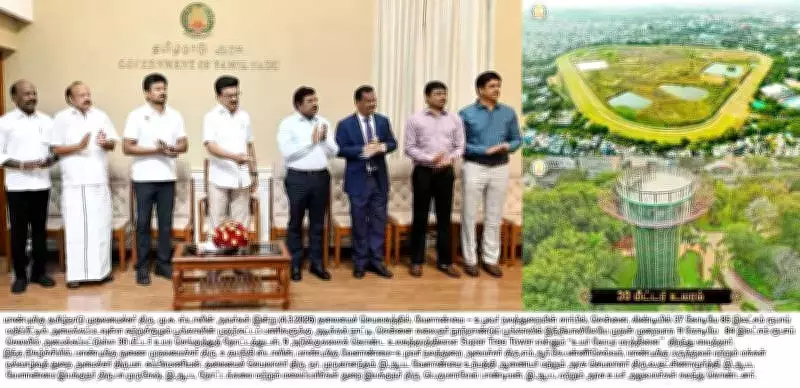
The newly announced eco-park, spanning 25 acres in Guindy, is being developed at a cost of 37.85 crore rupees. This ambitious project aims to enhance Chennai's green cover and biodiversity. It will feature thematic gardens, dedicated play zones for children, bird habitats to support local wildlife, serene water bodies, dense groves, and shaded walkways for public recreation. The park is designed not only as a recreational space but also to improve air quality and recharge groundwater levels, addressing critical environmental concerns in the urban landscape.
Simultaneously, Stalin inaugurated a 30-meter-high, nine-level supertree tower at the Kalaignar Centenary Park, constructed at an expense of 11.84 crore rupees. Touted as a first-of-its-kind structure in India, this tower offers visitors an unparalleled aerial view of Chennai's skyline, blending architectural innovation with ecological awareness. These initiatives underscore the government's commitment to creating sustainable urban spaces that prioritize both nature and community well-being.

Comprehensive Infrastructure Projects Worth 4000 Crore Inaugurated
Beyond the green projects, Chief Minister Stalin inaugurated a wide array of infrastructure developments totaling approximately 4000 crore rupees. At the Secretariat, he officially opened 229 completed projects valued at 2,732.77 crore rupees under the municipal administration and water supply department. Additionally, foundation stones were laid for 19 other works worth 655.36 crore rupees.
This extensive portfolio includes:
- Combined drinking water schemes to ensure better water access.
- Expansion of underground sewerage systems for improved sanitation.
- Tertiary treatment plants to enhance wastewater management.
- Installation of smart water meters to promote efficient usage.
These efforts are aimed at bolstering Chennai's urban infrastructure, addressing long-standing issues related to water supply and sanitation.
Cultural, Educational, and Sports Enhancements Unveiled
In the cultural sphere, Stalin inaugurated the 63-crore rupee 'Muthamizh Arignar Kalaignar Arangam' at the State College campus. This air-conditioned auditorium, covering 60,672 square feet and seating 2,042 people, honors the late Chief Minister M Karunanidhi. It is expected to serve as a hub for cultural and academic events, enriching the city's artistic landscape.
Educational initiatives saw the distribution of laptops under the 'Ulagam Ungal Kaiyil' scheme, along with the inauguration of 22 smart classrooms at a cost of 15 crore rupees. For law enforcement, buildings worth 75.80 crore rupees were opened, including 200 quarters and two police stations, while 2,138 TNHB apartments in Sholinganallur, Ambattur, and Mahakavi Bharathiyar Nagar were handed over to personnel, addressing housing needs.
In sports, 14 projects worth 42.94 crore rupees were inaugurated, featuring a district complex in Chengalpet and mini stadiums in Namakkal and Salem. Three additional sports projects valued at 37.84 crore rupees were also launched, promoting athletic development across the region.
Historical Recognition and Road Renaming
Adding a historical touch, Stalin renamed the Marina Loop Road as 'Sindhanai Sirpi Singaravelar Salai'. This change honors labour leader Singaravelar, who organized India's first May Day celebration in Chennai in 1923, recognizing his contributions to the labor movement and the city's heritage.

Overall, these initiatives represent a holistic approach to urban development in Chennai, combining environmental sustainability, infrastructural upgrades, cultural enrichment, and social welfare. The projects are poised to significantly enhance the quality of life for residents while setting a benchmark for green urban planning in India.