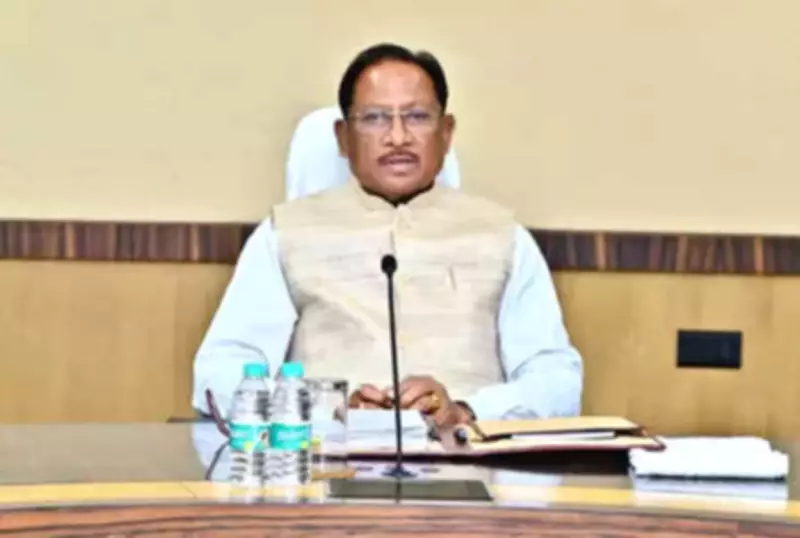
In a significant move to bolster law enforcement and governance infrastructure, the Chhattisgarh cabinet, chaired by Chief Minister Vishnu Deo Sai, approved a series of key decisions during a meeting held at the secretariat in Raipur on Wednesday. The approvals span across multiple sectors, including narcotics control, policing, aviation, digital connectivity, and urban development, reflecting the state government's comprehensive approach to addressing contemporary challenges.
Strengthening Anti-Narcotics and Policing Measures
To intensify the crackdown on narcotics trafficking, the cabinet sanctioned the creation of 100 new posts for establishing district-level anti-narcotics task forces. These units will be operational in ten critical districts: Raipur, Mahasamund, Bilaspur, Durg, Bastar, Surguja, Kabeerdham, Jashpur, Rajnandgaon, and Korba. This initiative aims to enhance surveillance and enforcement capabilities at the grassroots level, targeting drug-related activities more effectively.
In another pivotal decision for law enforcement, the cabinet approved 44 new posts for the formation of a Special Operations Group (SOG) under the Special Branch at the police headquarters. The SOG is designed to be a rapid-response unit, trained to handle major or sudden incidents, stabilize ground situations, and neutralize serious threats promptly. This move is expected to improve the state's preparedness for high-risk scenarios and emergencies.

Boosting Aviation and Digital Infrastructure
On the aviation front, the cabinet cleared guidelines to establish Flight Training Organisations (FTOs) at airports and airstrips across Chhattisgarh. This initiative, to be developed through private participation, will facilitate pilot training and create allied opportunities in areas such as aircraft recycling, helicopter bunking, and aero-sports facilities. Officials highlighted that this step could spur job creation and boost the state's aviation sector.
To address digital connectivity gaps, especially in geographically difficult and Left-wing extremism (LWE)-affected areas, the cabinet approved a Mobile Tower Scheme. This plan aims to simplify and expedite permissions for service providers, with the goal of improving access to essential services. Enhanced connectivity is projected to benefit welfare schemes like the Public Distribution System (PDS), direct benefit transfers, health, education, and emergency response systems, including Dial-112.
Advancing Tech Governance and Urban Development
In a push for modernized governance, the cabinet approved the Chhattisgarh Cloud First Policy. Under this policy, government departments and autonomous bodies will procure cloud services exclusively from providers empanelled by the Government of India's IT ministry or from secure India-based data centres and disaster recovery centres. The migration timeline sets low-priority applications and archived data to be moved by 2027-28, with high-priority services following by 2029-30. All new applications will be built on cloud-native technology, with further policy details to be announced later.
For urban governance, the cabinet decided to transfer 35 residential colonies built by the Chhattisgarh Housing Board and the Raipur Development Authority to municipal bodies. This move addresses issues faced by residents, such as gaps in civic services and the "double burden" of paying property tax to local bodies and maintenance charges to agencies. The handover is expected to streamline the delivery of water, power, roads, and sanitation services, while reducing extra maintenance costs for residents.
Promoting Planned Development
To support planned development in the capital region, the cabinet cleared the construction of a large multi-storey office complex in Nava Raipur Atal Nagar. This facility will house government departments and state-run bodies, with space allocation designed for optimal land use, promoting efficiency and centralized operations.

Additionally, to accelerate land decisions for riverfront-linked development, the cabinet authorized district collectors to allot government land for projects in Sirpur and the Arpa area. The allotment will be at a nominal premium of Re 1 and a minimal rent, taking into account the financial position of the special area development authorities, thereby facilitating infrastructure projects without undue financial strain.