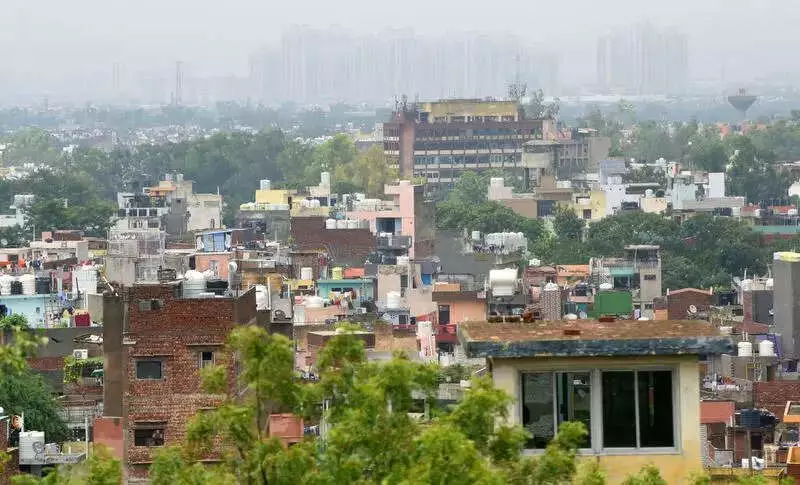
New Delhi's recent administrative reshuffle has created unexpected complications for residents of Naraina village. The historic settlement, dating back to the 14th century, now finds itself split across multiple districts following the city's reorganization.
Administrative Fragmentation
Previously, Naraina village fell entirely under New Delhi district and Delhi Cantonment subdivision. The government's decision to restructure eleven districts into thirteen has dramatically changed this arrangement. Different sections of the village now belong to three separate districts: Central, West, and New Delhi. The village also spans four different subdivisions: Patel Nagar, Karol Bagh, Rajouri Garden, and Delhi Cantonment.
Residents describe invisible administrative borders cutting through their neighborhood. "Even a short walk through the village means crossing into another district or subdivision," one resident explained. This fragmentation complicates their access to basic government services that were previously straightforward.

Practical Problems Emerge
The division creates tangible difficulties for village families. Devender Tanwar, a local resident, provided a concrete example from Shankar Lal Gali. "Out of 60 houses in our lane, 20 houses are now in Central district and 40 in New Delhi," he said. "Even members of the same family have to visit different district offices for the same work."
Residents worry particularly about land-related matters. Filing complaints against revenue officials or seeking property services becomes confusing when people don't know which subdivision to approach. Many villagers remain unaware of these changes, but advocates predict problems will multiply as people discover the implications.
Advocacy Group Intervenes
The Centre for Youth Culture Law and Environment has taken formal action regarding the situation. This public policy advocacy organization has written to Chief Minister Rekha Gupta requesting her intervention.
In their letter, Aditya Tanwar, the organization's New Delhi district head, warned about future administrative complications. He highlighted potential problems with land records, registrations, and grievance redressal systems.
Paras Tyagi, co-founder of the organization, has urged the government to reconsider its decision. He advocates placing Naraina and other similarly affected villages entirely within single revenue districts and subdivisions to maintain administrative coherence.
Government's Rationale
Revenue department officials defend the reorganization as necessary for improving administrative efficiency and public convenience. One official explained that the new district boundaries align with Municipal Corporation of Delhi zones and ward boundaries.
During the restructuring process, authorities discovered that several 'revenue villages' were split across multiple wards. This discovery prompted adjustments to create more logical administrative units.
"For revenue administration like land records, Naraina village is assigned to New Delhi, the district where the majority of its area lies," the official stated. For general administrative services including property and document registrations, ward boundaries will apply instead.
Dual Approach Implementation
The government has adopted a two-pronged strategy to address different administrative needs. Sensitive revenue work will be centralized to avoid land disputes, while public-facing services will be decentralized to reduce overcrowding and travel time for residents.
Another revenue official explained that the National Generic Document Registration System portal automatically directs citizens to appropriate sub-registrar offices based on their addresses. This automation aims to minimize confusion despite the complex new boundaries.
The reorganization represents Delhi's ongoing administrative evolution, but Naraina's residents experience its immediate practical consequences. As the city adjusts to new boundaries, villages like Naraina navigate unexpected administrative divisions in their daily lives.