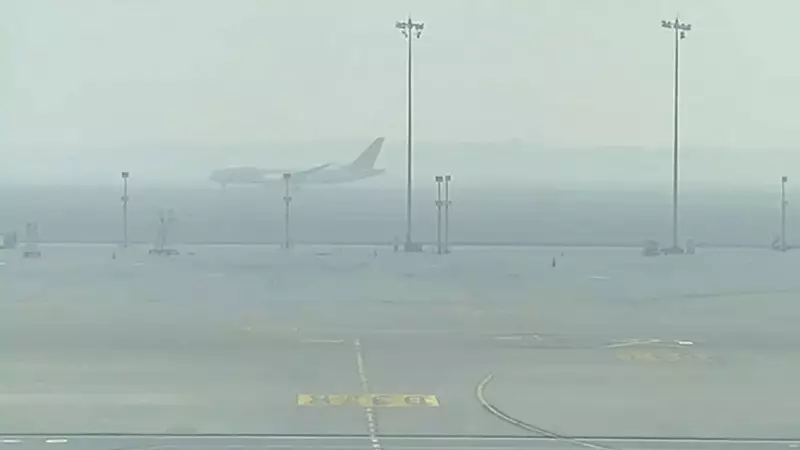
For the second consecutive day, severe fog conditions have thrown flight operations into disarray at the Indira Gandhi International (IGI) Airport in Delhi. On Tuesday morning, a total of 118 flights were cancelled and 16 were diverted, causing significant travel chaos for thousands of passengers.
The Annual Winter Challenge for Aviation
This scenario repeats each winter, particularly in December, when dense fog blankets North India. The impact is magnified because Delhi's IGI Airport is the nation's busiest aviation hub, handling over 1,500 flight movements every day. Any disruption here creates a ripple effect across the entire Indian air travel network, leading to cascading delays and cancellations nationwide.
The core issue is drastically reduced visibility. Just like road vehicles, aircraft face immense difficulty in taking off and landing when pilots cannot see the runway clearly. This forces air traffic control to space out flight movements for safety, slowing down the entire system. The consequences are multi-layered:

- Flight crews can exceed their legally permitted duty hours, making them unavailable.
- Aircraft get stuck out of position, forcing airlines to scramble for alternative planes.
- Night operation curfews at other airports can further complicate schedules.
This perfect storm creates a backlog that often takes many hours to clear, extending passenger inconvenience long after the fog lifts.
How Airports Combat Low Visibility: The Role of CAT-III Systems
The aviation industry relies on a combination of strict visibility parameters and advanced technology to manage these conditions. The cornerstone of this effort is the Instrument Landing System (ILS), which provides precise guidance to pilots during approach and landing.
These systems are categorized based on their capability:
- CAT I: Allows landing with a Runway Visual Range (RVR) above 550 metres. RVR is the distance a pilot can see along the runway.
- CAT II: Permits landing with an RVR between 300 and 549 metres.
- CAT III: The most advanced category, enabling landing in extremely low or near-zero visibility. It has sub-categories B and C, with CAT IIIC allowing operations with literally zero visibility.
For a flight to operate in CAT III conditions, three elements must align: the aircraft must have specific certified equipment, the pilot must be specially trained, and the airport runway must be equipped with the necessary advanced technology.
Delhi's Infrastructure and Limitations
Delhi airport is equipped with four runways. Three of them are CAT-IIIB compliant at both ends, while the fourth supports CAT-I operations. Despite this infrastructure, disruptions occur because not all aircraft or pilots are certified for CAT-IIIB operations.
Furthermore, regulations by the Directorate General of Civil Aviation (DGCA) prohibit take-offs when visibility drops below 125 metres. In such cases, flights are typically diverted to alternate airports. Airlines mitigate fuel concerns by carrying extra fuel when such weather is forecast.
Currently, only six Indian airports—Delhi, Lucknow, Jaipur, Amritsar, Bengaluru, and Kolkata—are equipped for CAT IIIB operations. India does not yet have a single airport capable of the highest CAT IIIC standard, a capability available at major international hubs like London's Heathrow and New York's JFK.
The ongoing fog-related disruptions underscore the critical need for broader adoption of advanced landing systems and pilot training to enhance resilience against India's annual winter weather challenge.