Delhi's Shelter Crisis: The Stark Gap Between Paper and Reality
If numbers alone could provide warmth, Delhi's homeless population would sleep comfortably every winter. Official records paint a picture of preparedness: 322 night shelters across the city with a total capacity of nearly 20,000 beds. The Delhi Urban Shelter Improvement Board website lists each facility with precise figures, creating an illusion of a robust safety net. One shelter claims space for 540 people, another for 280, and dozens more promise hundreds of beds. On paper, it seems adequate to ensure no one faces the biting cold outdoors.
The Ground Truth Reveals a Different Story
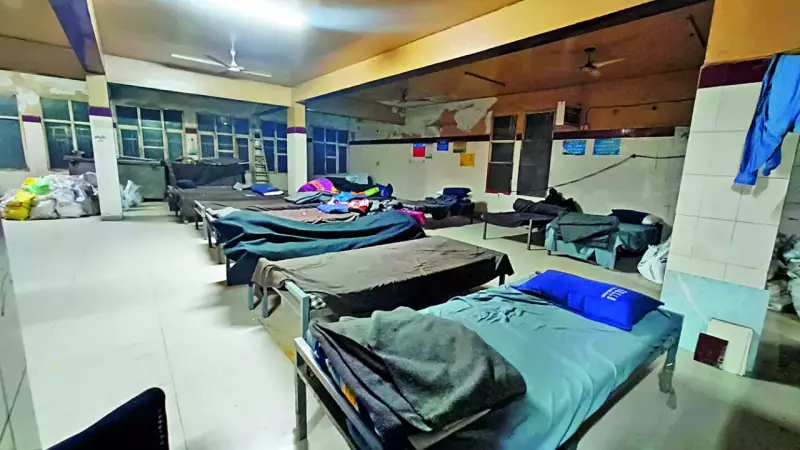
Step inside these shelters, and the mathematical comfort vanishes. The Commercial Building in Motia Khan serves as a prime example. Listed with a capacity for 540 individuals, it had only 15 beds available on a recent Tuesday. That represents less than 3% of its claimed capacity. To visualize the discrepancy, if this shelter suddenly reached its official capacity, each bed would need to accommodate 36 people.
Staff members admitted the space could hold a few more mattresses, but housing over 500 people remained impossible. "This is the only shelter with that code. This is the space we have," said the person on duty, his expression reflecting the impossibility of meeting the listed numbers.

A Pattern of Mismatch Across the City
This discrepancy repeats across multiple locations:
- Chabi Ganj Ward-I community hall, listed for 100 people, had only 38 beds
- The Chabi Ganj Community Centre above it, claiming 280 capacity, operated at just 6% with 18 beds
- Yamuna Bazar shelter, listed for 50, had only 19 beds ready
- Mori Gate's Gole Chakkar, with a listed capacity of 50, offered just 18 beds
- Majnu ka Tilla facilities showed similar gaps: a 100-capacity hall had 20 beds, while 50-capacity shelters had 15-20 beds
While some rooms might theoretically hold the claimed number of people, they lacked sufficient beds or mattresses. Only the tents, which boast a capacity of 20, reportedly had matching numbers of beds.
Not a New Problem, But a Persistent One
This issue isn't recent. During winters over the past two to three years, capacity has consistently hovered around 19,000-20,000 beds on paper, while the disparity between listed and actual availability has persisted. The pattern highlights continuing administrative apathy toward Delhi's homeless population.
When confronted with these findings, senior government officials promised action. A senior DUSIB official stated, "We will definitely check if there is any discrepancy." He explained the concept of 'bedded' and 'non-bedded' capacity, noting that when beds are installed, usable capacity decreases, while non-bedded areas can accommodate more people.
Regarding Motia Khan, he mentioned that several people were shifted into the building following a court order, which influenced capacity figures. At other shelters, beds were added after COVID-19. An audit is being planned, as many available beds remain unused. "In any case, no one will be sent back to sleep on the road," he assured.
Unanswered Questions and Systemic Issues
However, officials provided no explanation for why capacity figures remain so much higher than actual, usable arrangements. If beds aren't in place, why are the numbers boosted? Shouldn't capacity reflect the real, ready-to-occupy situation on the ground? These questions received no clear answers.
Even considering both bedded and non-bedded capacity, several shelters lack the physical space to hold 100-200 people. In others, space exists but lacks beds or mattresses.
Actual occupancy generally aligned with the number of physically available beds. For instance, a Nizamuddin Basti shelter listed for 300 had 95 residents on January 13th and 91 beds available on Tuesday—a much more realistic figure.
At Mori Gate, staff revealed that when shelters reach their limit, residents get redirected to nearby facilities, even after combining beds in a "2-in-1" setup. This demonstrates that the issue isn't low demand but rather a significant gap between listed capacity and ground reality.

Experts Demand Accountability and Action
Shelter capacity should reflect beds that exist, are usable, and ready each night—not theoretical numbers in government files. Experts argue that when Delhi claims 19,724 beds but can provide only 6,500-7,000 on the ground, officials must be held accountable. Even on the coldest winter nights, thousands of homeless people sleep on road dividers, footpaths, and open plazas.
Activist Sunil Kumar Aledia, who works with homeless people and construction workers, observed similar capacity mismatches recently. He stated, "The alarming mismatch between declared capacity and actual beds points to systemic misreporting and serious neglect of basic infrastructure. Based on actual availability, Delhi can provide sleeping arrangements for only 6,500 to 7,000 people, grossly inadequate for a city of this size."
He called for:
- An independent physical audit of all DUSIB shelters
- Provision of beds, mattresses, and basic facilities according to declared capacity
- Correction of misleading data on the DUSIB website
- Revision of winter action plans
- Public disclosure of actions taken to ensure transparency and accountability
Indu Prakash Singh, a member of the state-level shelter monitoring committee, added, "I raised this issue in the last meeting. Shelters run far below their listed capacity, yet the department misreports numbers. Where have the beds actually gone? Every mattress that exists should be on the ground today. We need accurate figures and real focus on improving conditions."
The Bigger Picture: Delhi's Inadequate Response
Even if Delhi genuinely had capacity for nearly 20,000 homeless individuals, it would still fail to provide shelter for everyone. The internationally accepted figure for homelessness sits at 1% of a city's population. That Delhi manages to house only around 7,000 people shows how stark the situation truly is. The city's response remains inadequate, leaving vulnerable populations exposed to winter's harsh realities.