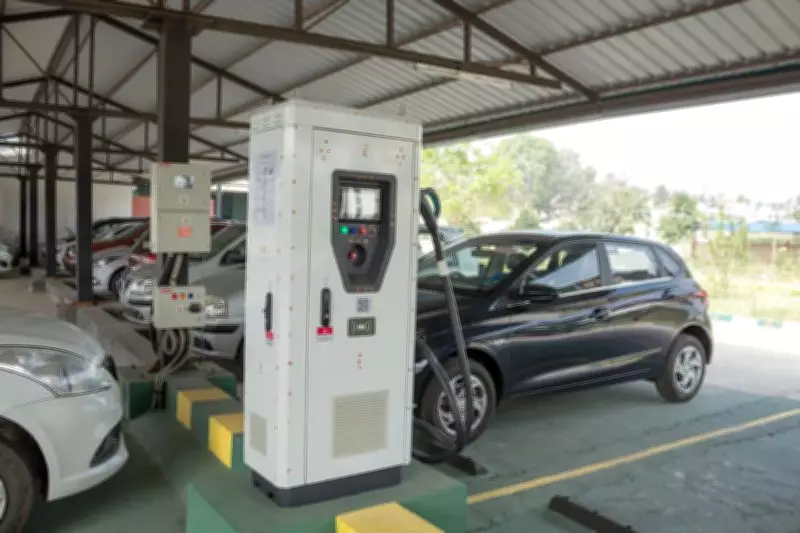
The Delhi Government, under its newly introduced EV Policy 2026, has unveiled an ambitious roadmap to develop nearly 32,000 public electric vehicle (EV) charging points across the Capital by 2030. Chief Minister Rekha Gupta stated that the expansion of charging infrastructure will be central to the city’s transition towards clean mobility.
Data-driven planning for charging network
According to the Chief Minister, the charging network has been planned on the basis of detailed demand assessment and data modelling, taking into account projected EV adoption, charging patterns, home charging availability and future public charging requirements. The government said the infrastructure will be developed ahead of demand to encourage more people to switch to electric vehicles.
Integration with central scheme
Gupta said Delhi would build on the Centre’s support under the PM E-DRIVE Scheme, under which 382 charging station locations have already been sanctioned for the national capital. The Delhi Government will supplement these with additional state investment to bridge the remaining infrastructure gap and ensure charging facilities are available across the city.

Multi-pronged charging ecosystem
The policy also proposes a multi-pronged charging ecosystem, including home charging, workplace charging, public charging stations and battery-swapping facilities. While private vehicle owners are expected to rely largely on home and workplace charging, public charging stations will cater to users without dedicated parking, commercial fleets, taxis and visitors. Battery swapping will continue to support high-usage electric two-wheelers and three-wheelers by allowing batteries to be replaced within minutes.
High-capacity hubs for commercial vehicles
The government has also proposed dedicated high-capacity charging hubs for electric buses, commercial fleets and N1 and N2 goods carriers at logistics hubs, freight corridors and transport centres. It plans to facilitate the deployment of this infrastructure before the upcoming winter season to accelerate the adoption of electric trucks and reduce emissions from the commercial transport sector, the CM said.
Nodal agency and stakeholder involvement
Delhi Transco Limited (DTL) will act as the nodal agency for planning and facilitating the rollout of charging infrastructure in coordination with power distribution companies, urban local bodies and other government departments. Resident Welfare Associations (RWAs), land-owning agencies, government institutions and private establishments will also be encouraged to identify suitable locations for charging stations.
CM’s vision for clean mobility
“Charging infrastructure is not merely about installing chargers. It is about creating the confidence required for citizens and businesses to adopt electric vehicles,” Gupta said, adding that the planned network of 32,000 public charging points would support cleaner air, sustainable mobility and help position Delhi among the country’s leading EV-ready cities.