

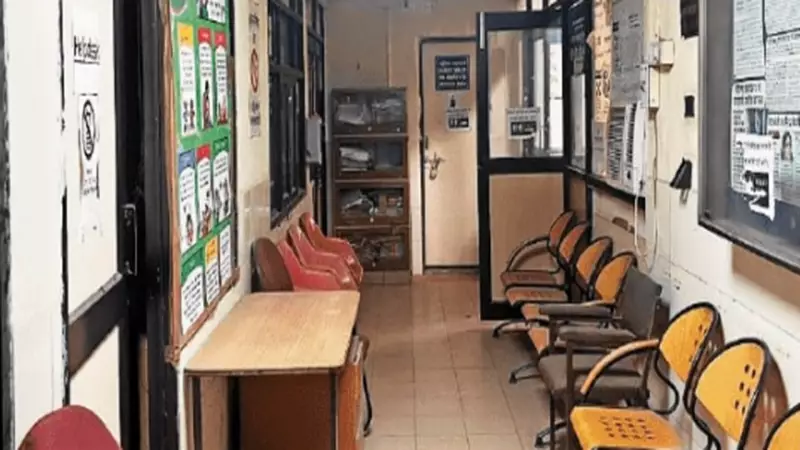
For countless women facing violence and discrimination, the Delhi Commission for Women (DCW) served as their first refuge for nearly three decades. Today, the corridors of its Vikas Bhawan office stand silent and abandoned, with locked doors replacing the once-bustling support system.
A Commission That No Longer Commissions
Ask the security guard for directions to Mahila Aayog, and he barely looks up before responding with a dismissive shrug: "Bandh hai" (It's shut). Climb to the second floor to verify, and you'll find empty hallways that once echoed with voices seeking justice. An A4 sheet taped by the lift reading "Commission for Women" offers the only indication of what the space once represented.
Every door remains locked - the main office, the Helpdesk, even the Mobile Helpline room. This complete shutdown results from leadership vacuum that began in January 2024 when then-chairperson Swati Maliwal resigned after her election to Rajya Sabha. The situation worsened when all commission members completed their terms in July 2024.

Systematic Dismantling of Critical Services
The collapse accelerated in May 2024 when the Women and Child Development Department ordered the removal of 223 contractual staffers over alleged "improper" hiring practices. With leadership gone and staff drastically reduced, the commission has become virtually nonfunctional.
Delhi government has given additional charges for both DCW and Delhi Commission for Protection of Child Rights (DCPCR) to one IAS officer. However, this stop-gap arrangement violates the Delhi Commission for Women Act, 1994, which mandates that the chairperson must be an individual deeply committed to women's welfare.
A former DCW member explained the critical flaw in this approach: "These are public-facing institutions that demand fulltime, undivided attention because the cases are very sensitive. An overburdened officer simply cannot provide the leadership, accessibility, or accountability that the commission urgently requires."
Lives Left in Limbo as Programs Collapse
The DCW's moribund status has pulled the plug on several crucial programs that once defined its mission to protect women's rights and provide immediate assistance.
The complete breakdown includes:
- The Helpdesk - first touchpoint for women seeking in-person support
- The Rape Crisis Cell created under Delhi High Court directions
- Crisis Intervention Centres recognized by Delhi Police
- Mahila Panchayat - grassroots grievance redressal platform
- The crucial DCW helpline 181 shifted to WCD Department
Suhail from Sofia NGO, which ran the Mahila Panchayat program, expressed deep concern: "We had 80 centres in urban villages and backward areas. Many cases were pending when they were shut. It still makes us emotional when we think of how we redirected them to WCD or courts and left them on their own."
The human cost of this institutional collapse becomes painfully clear through individual stories. Neha from Bhajanpura recalled how her neighbor's domestic violence case was handled "so well" two years ago that the woman now lives with dignity. But when she returned recently with a dowry harassment case, she was simply redirected elsewhere.
"Poor families cannot even step outside their lane. Ab kahan jaayenge hum... vo ab aise hi baithi hai (Now where will we go... she's still in the same state)," Neha lamented.
Another person who monitored the Rape Crisis Cell revealed the ongoing tragedy: "So many survivors still call us. And all we can say is: we do not work there anymore. The saddest part is that they are not cases - they are lives."
Parallel Crisis in Child Rights Protection
The crisis extends beyond women's protection. The Delhi Commission for Protection of Child Rights (DCPCR) has had no full-time chairperson since July 2023, with an IAS officer temporarily handling the role. Activists warn this lack of leadership hampers quick action on child rights violations.

While almost all DCW functions have ceased, the nodal 181 Helpline continues operating under the WCD Department. Launched in 2012 after the Nirbhaya gangrape case, this toll-free service provides 24/7 emergency support. Between September 2024 and March 2025, the helpline recorded 8,594 cases according to RTI data.
An official stated that the selection process for full-time chairperson and six members of DCPCR is ongoing and likely to be finalized soon. However, for the women climbing those empty stairs seeking help today, that promise offers little comfort as they're redirected to the National Commission for Women, their pleas for immediate assistance unmet.





