

Delhi's 10th Yamuna Bridge: A Decade of Delays Exposes Systemic Flaws in Infrastructure
A project designed to save precious minutes for daily commuters has instead squandered years, revealing how poor planning, piecemeal clearances, and serial delays can inflate public costs far beyond what official documents suggest. The stop-start saga of Delhi's 10th road bridge over the Yamuna, known as Barapullah Phase III, exemplifies how major public initiatives often derail not from a single catastrophic failure, but from a cascade of lapses—beginning with land acquisition, extending through permissions and engineering challenges, and culminating in accountability gaps.
The Initial Failure: Construction on Unacquired Land
The most striking and fundamental reason for the delay emerged less than a year after construction commenced. Residents from Nangli Razapur village, situated between the Nizammuddin bridge and DND near Smriti Van, arrived at the site demanding a halt to work, claiming ownership of the land. This development caught even project officials by surprise.
The dispute over approximately 8.5 acres of land dragged on for nearly seven years, from 2016 to 2023, primarily due to protracted negotiations over compensation. The land had been classified as 'riverine,' with a government-notified rate of Rs 17 lakh per acre. However, landowners insisted on 17 times that amount—Rs 3 crore per acre. In 2017, Ambedkar University was tasked with conducting a social impact assessment to evaluate the project's effects on local communities. Throughout this period, work on a critical 700-meter alignment and a key pillar remained stalled. Ultimately, in 2024, compensation was settled at Rs 17.6 lakh per acre based on market value.

Surprises That Should Have Been Anticipated
Nearly a decade after project approval, officials in 2023 identified around 300 trees along the alignment that required transplantation, pruning, or felling. These trees were located on land acquired years after construction began, necessitating fresh permissions and additional compliance measures, which led to further waiting.
The Delhi Preservation of Trees Act and approvals from the Supreme Court-appointed Central Empowered Committee came into play. A subsequent survey revealed that only 85 trees needed to be cut, while the rest could be transplanted or pruned without disrupting the alignment. Approvals for approximately 170 trees were finally granted in July 2025.
This pattern repeated across other issues: elements that should have been identified during the planning phase only surfaced after construction was underway. High-tension lines required relocation, clearances had to be revisited, and surveys needed redoing. While each issue might seem manageable in isolation, collectively they narrate a story of a project that advanced more swiftly on paper—with an initial completion estimate of 30 months—than in practical preparation.
Engineering Challenges and the Pandemic Impact
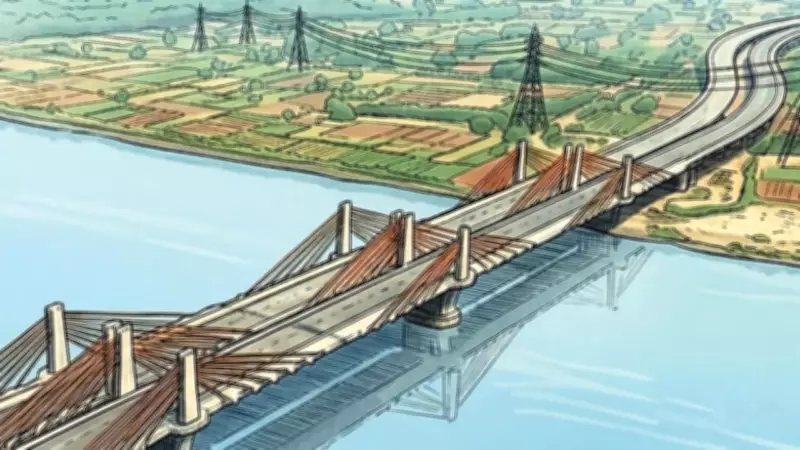
To be fair, the project was inherently complex. Constructing across the Yamuna floodplain involves difficult soil conditions, deep foundations, and unusual engineering demands. Floods disrupted work, and a suspected pier tilt had to be stabilized before progress could continue.
The foundations for the piers had to extend nearly 50 meters deep, with wells about 14 meters in diameter, underscoring that this was no ordinary flyover task. Then, the COVID-19 pandemic struck over two years after the original completion deadline, severely disrupting labor and logistics. Between 2019-20 and 2022-23, project completion inched from about 80% to just 82%.
Inauguration Without Completion: A Familiar Pattern
This project also reflects a now-common trend in Indian infrastructure: inaugurating segments of a larger work with great fanfare while the full public benefit remains distant. In August 2021, two small loops were opened, with state politicians promising swift completion of the remaining 90%-plus of the project. This practice of repeated ribbon-cutting—where a single project yields multiple photo opportunities but no clear timeline for final delivery—has become almost a national norm.

The Real Cost Beyond Official Overruns
Depending on whether the tender cost or the original sanctioned estimate is used as a benchmark, the 10-year delay is projected to add roughly Rs 400 crore to Rs 600 crore. However, this figure represents only a fraction of the true cost borne by Delhi's commuters. Factoring in thousands of tons of extra CO2 emissions from idling engines at DND and Nizammuddin bridge, lost productivity hours in gridlock, and the stress and fuel wasted in daily congestion, the real cost of this delay multiplies several times over.
This is particularly concerning in a city that already lacks bridges by global standards. London and Paris have more than twice as many bridges across the Thames and Seine as Delhi has across the Yamuna, despite having populations half or less than that of the capital region. During the decade that Barapullah Phase III overshot its schedule, the population of Delhi, Noida, and Greater Noida grew by millions, accompanied by a significantly higher vehicle-to-population ratio.
By late 2025, the situation had escalated to trigger an anti-corruption inquiry into the delays, cost overruns, and arbitration payouts associated with the project. As of mid-March, at least eight concrete piers remained unconnected to the elevated stretches near the Yamuna, though work was progressing at full pace, raising hopes that the eighth deadline for completion—June of this year—might not be missed.
Innovative Features of the Bridge
Despite the delays, the bridge promises several forward-thinking elements:
- Designed with Non-Motorists in Mind: Unlike most Delhi bridges, it will feature dedicated cycle tracks and footpaths, offering a more comprehensive mobility design.
- Nine Loops for Smoother Exits: The project includes nine loops—four at Sarai Kale Khan and five at Mayur Vihar—to distribute traffic efficiently and prevent congestion at choke points.
- Distinctive Engineering: Officials describe the river section as an 'extradosed bridge' with a pier-supported elevated structure, aimed at reducing the number of piers in the Yamuna's active flow zone.





