

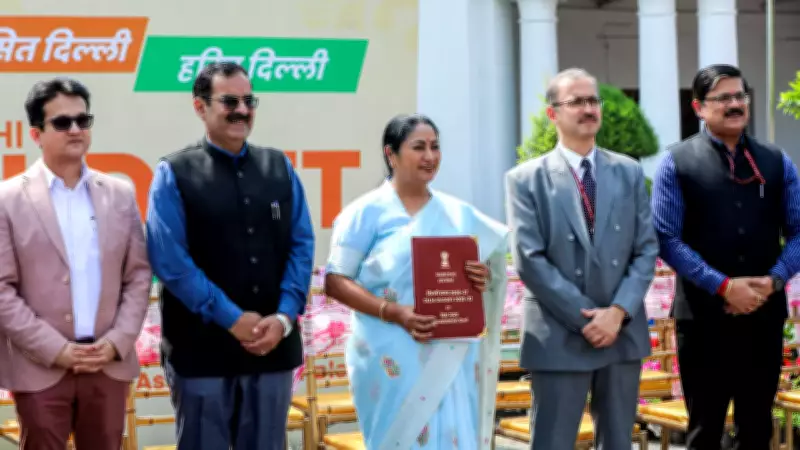
Delhi Government Presents Ambitious Rs 1.03 Lakh Crore Budget for 2026-27
The Delhi government has officially presented its budget for the fiscal year 2026-27, with a substantial total outlay of Rs 1,03,700 crore. This financial plan is strategically designed to bolster key sectors including education, health, transport, urban development, and social welfare, aiming to significantly improve public services, expand infrastructure, and provide robust support for women, students, and marginalized communities across the city.
Budget Outlay Trends and Revenue Sources
The budget outlay has shown a progressive increase over recent years, reflecting the government's commitment to development. The figures are as follows: Rs 75,800 crore in 2022-23, Rs 78,800 crore in 2023-24, Rs 76,000 crore in 2024-25, Rs 1,00,000 crore in 2025-26, and Rs 1,03,700 crore for 2026-27. The total receipts for 2026-27 amount to Rs 1,03,700 crore, derived from diverse sources.
Own Tax Revenue constitutes the largest share at Rs 74,000 crore (71.3%), broken down into: GST at Rs 43,500 crore (58.8%), VAT at Rs 8,500 crore (11.5%), Stamp & Registration at Rs 11,000 crore (14.9%), State Excise at Rs 7,200 crore (9.7%), and Vehicle Tax at Rs 3,800 crore (5.1%).

Other revenue streams include Non-Tax Revenue of Rs 900 crore (0.9%), Central Transfers & Grants of Rs 7,092 crore (6.7%), Capital Receipts of Rs 20,068 crore (19.4%), and an Opening Balance of Rs 1,640 crore (1.6%). Capital Receipts are further detailed with Market Borrowings from RBI at Rs 16,700 crore, an interest-free loan from the Government of India under SASCI at Rs 2,500 crore, External Aid Projects at Rs 380 crore, and Loan Recovery at Rs 488 crore.
Sector-Wise Allocation and Expenditure Breakdown
The budget allocates funds across various sectors to address critical needs. The sector-wise distribution is as follows:
- Education: Rs 19,326 crore (18.6%)
- Health: Rs 13,034 crore (12.6%)
- Transport & Roads: Rs 12,613 crore (12.7%)
- Housing & Urban Development: Rs 11,572 crore (11.2%)
- Social Welfare: Rs 10,537 crore (10.2%)
- Water & Sanitation: Rs 9,000 crore (8.7%)
- Public Debt: Rs 4,254 crore (4.1%)
- Energy: Rs 3,938 crore (3.8%)
- Interest Payments: Rs 2,734 crore (2.6%)
- Agriculture & Rural: Rs 1,777 crore (1.7%)
- Others: Rs 14,915 crore (14.4%)
In terms of budget composition, Revenue Expenditure accounts for Rs 72,900 crore (70.3%), while Capital Expenditure is Rs 30,799 crore (29.7%). Additionally, Schemes and Projects receive Rs 62,550 crore (60.3%), and Establishment costs are Rs 41,150 crore (39.7%).
Key Initiatives and Projects
The budget introduces several important initiatives aimed at enhancing public welfare and infrastructure. Notable allocations include:

- Free bicycles for Class IX girls: Rs 90 crore to improve school access and encourage education.
- New medical college at Dwarka: Rs 50 crore to expand healthcare education and training facilities.
- ANMOL scheme for newborn screening: Rs 25 crore for early disease detection and intervention.
- Hostel buildings at MAM: Rs 50 crore to support medical students with accommodation.
- Delhi Unified Metropolitan Transport Authority (DUMTA): Established to streamline urban mobility and improve transport efficiency.
- Sewer and Yamuna cleaning projects: Rs 1,500 crore allocated via Delhi Jal Board for environmental cleanup.
- New fire stations across Delhi: Rs 50 crore to strengthen emergency response capabilities.
- Mini-secretariats in all districts: Rs 100 crore for improved public service delivery and administrative efficiency.
- Delhi Lakhpati Bitia Scheme: Rs 128.5 crore for financial support to girls until graduation, promoting education and empowerment.
- E-auto subsidy for women and transgender drivers: Rs 20 crore to encourage sustainable transport and inclusivity.
- 50,000 CCTV cameras for women's safety: Rs 100 crore to enhance security in public spaces.
- Free LPG cylinders during Holi and Diwali: Rs 260 crore to support households during festive seasons.
- 750 Ayushman Arogya Mandirs: To be established this year to improve primary healthcare access.
- Chief Minister Development Fund: Rs 2,000 crore allocated for various development works across the city.
- Power subsidy: Rs 3,500 crore earmarked to provide relief to consumers and support energy affordability.
This comprehensive budget underscores the Delhi government's focus on holistic development, aiming to transform the city's infrastructure and social services for the benefit of all residents.





