

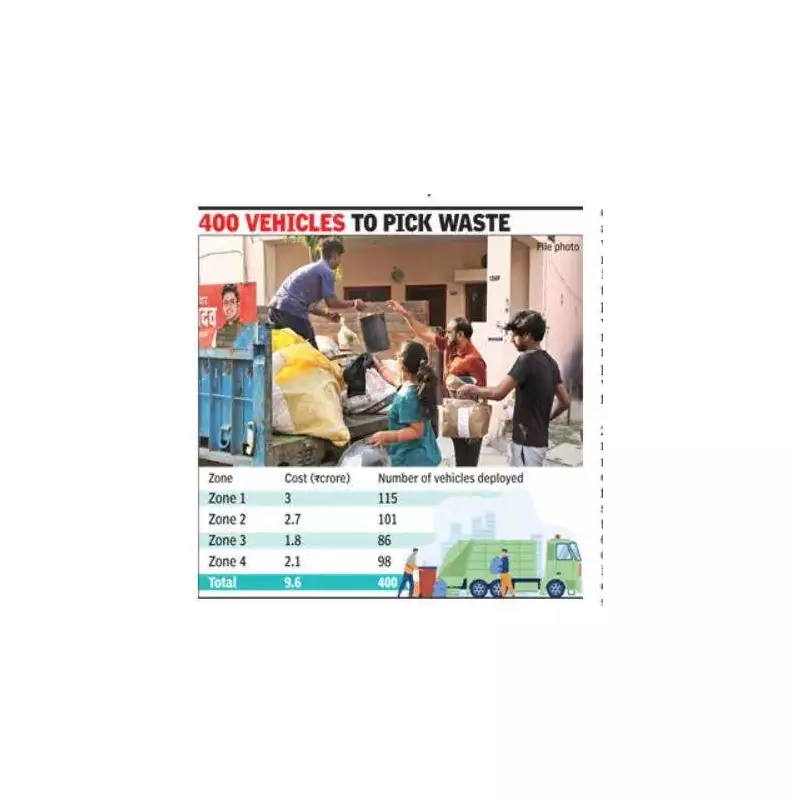
In a move highlighting persistent administrative delays, the Municipal Corporation of Gurgaon (MCG) on Thursday resorted to another short-term arrangement for the city's crucial doorstep waste collection service. The corporation issued six-month work orders worth a total of Rs 9.6 crore to four separate firms, dividing the responsibility across Gurgaon's four zones.
A Temporary Solution for a Persistent Problem
This latest decision has raised fresh concerns about planning failures and the civic body's continued reliance on stopgap measures for essential services. The contracts, covering the period from January to June this year, were awarded to one Gurgaon-based, two Faridabad-based, and one Rewari-based company. Collectively, these agencies will deploy 400 vehicles across the city starting Friday.
The zone-wise deployment of vehicles is as follows: 115 vehicles in zone 1, 101 in zone 2, 86 in zone 3, and 98 in zone 4. Officials clarified that residents will not have to pay separate user charges for this service; instead, the charges will be linked with property tax bills.

The Long-Term Plan Stuck in Bureaucracy
This six-month contract is explicitly a temporary fix. The MCG is awaiting approval from the state's Urban Local Bodies (ULB) department to appoint four agencies for a comprehensive five-year term for doorstep collection, segregation, and transportation of municipal solid waste. A proposal for this long-term project, with an estimated cost of Rs 327 crore, was sent to the ULB department on December 22, 2025.
MCG Executive Engineer Sunder Sheoran stated, "We finalised four agencies for doorstep waste collection and all will start work on Friday. The contracts are for six months, but if we receive ULB approval for the five-year term, these temporary contracts can be discontinued and replaced with a permanent arrangement."
A Cycle of Short-Term Failures
The current cycle of temporary contracts began after MCG terminated its contract with Ecogreen in June 2024 over poor performance. A subsequent one-year replacement private firm also failed to deliver, forcing the corporation into a pattern of short-term arrangements. Residents have consistently complained that this approach leads to inconsistent waste collection and mounting garbage problems.
The ULB department has revised the Request for Proposal (RFP) for this project multiple times. The latest revision in December 2025—the fifth—introduced a new clause stating that if MCG floats tenders zone-wise, no single private firm can be awarded more than one zone. The first RFP was issued on July 12, 2024, with subsequent changes, including an extension of the proposed contract period from five to seven years in January 2025.
This ongoing saga underscores the challenges in urban waste management and the impact of bureaucratic delays on ground-level civic services, leaving Gurgaon reliant on another half-year patchwork solution.






