

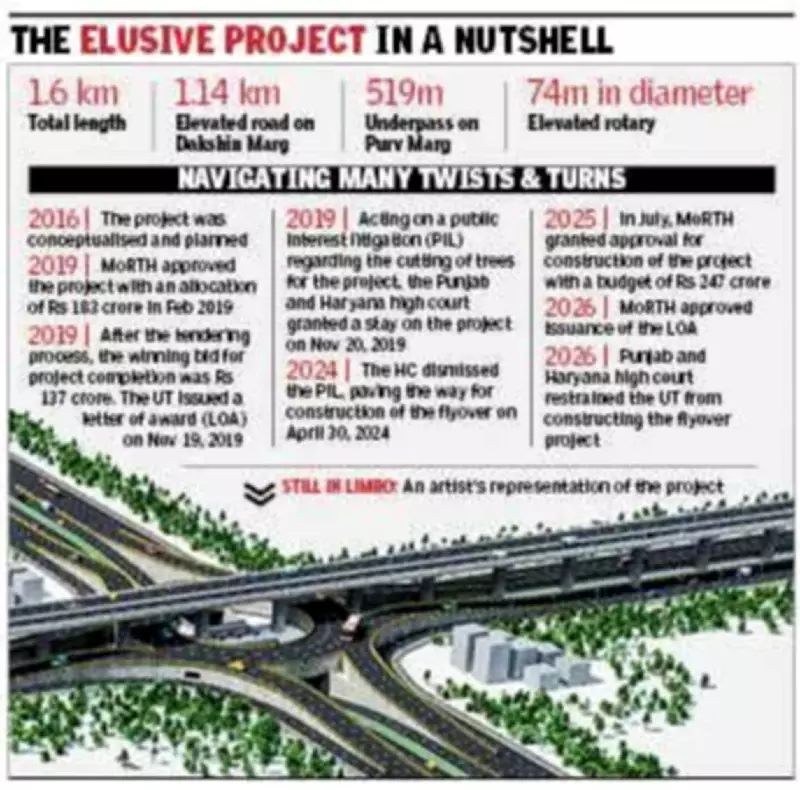
The Punjab and Haryana High Court has dealt a significant blow to the Chandigarh administration by restraining the construction of the Industrial Area/Sector 31 flyover. A division bench headed by Chief Justice Sheel Nagu ruled that the project violates the statutory Chandigarh Master Plan (CMP)-2031, which explicitly prohibits the construction of overbridges and flyovers within the city. The order came as a major setback, as the UT engineering department had recently awarded the construction contract after finalizing the tender process.
Court Order Details
In a detailed 21-page order, the division bench, comprising Chief Justice Sheel Nagu and Justice Sanjiv Berry, allowed the Chandigarh administration to construct an underpass at the Industrial Area/Sector 30 roundabout, noting that such a structure is permissible under the CMP-2031 to ease traffic congestion. However, the court issued a writ of prohibition restraining the administration from cutting any trees in and around the roundabout. The bench directed the UT to preserve the green, unique, and heritage status of Chandigarh, particularly Phase I, which includes sectors 1 to 30. Dakshin Marg, a key road, is an integral part of this heritage zone.
Mandate for Public Transport
The court also issued a writ of mandamus, directing the UT administration to promote and encourage the original ambience and character of the city by minimizing personal motorized vehicular traffic and adopting public transportation. The order emphasized that Dakshin Marg is integral to the Phase I Heritage Area, and no developmental activity can violate the CMP-2031. The court highlighted that the master plan states: 'Over bridges/flyovers are not recommended to be constructed in the entire city of Chandigarh due to heritage considerations, since they impact the visual city scape and cause inconvenience to pedestrians.'

The order further noted that Chandigarh is the last well-planned city in India, with unique features conceived by architect Le Corbusier. It stressed that the city was designed for non-motorized traffic, prioritizing pedestrians and cyclists over motor vehicles. The court expressed alarm over the rising number of motor vehicles, stating that Chandigarh has the highest per capita motor vehicle ownership in the country, with more vehicles than residents.
Project Background and Timeline
The proposed flyover project, with a total length of 1.6 km, included a 1.14 km elevated road on Dakshin Marg, a 519-meter underpass on Purv Marg, and an elevated rotary with a diameter of 74 meters. The project was first conceptualized in 2016 and received approval from the Ministry of Road Transport and Highways (MoRTH) in February 2019 with an allocation of Rs 183 crore. After tendering, a letter of award was issued in November 2019 for Rs 137 crore. However, a public interest litigation regarding tree cutting led to a stay from the High Court the next day. In April 2024, the HC dismissed the PIL, clearing the way for construction. In July 2025, MoRTH approved the project with a revised budget of Rs 247 crore, and a new letter of award was issued in 2026. The recent High Court order has once again halted the project.
Next Steps
The UT administration is legally examining the order and may consider moving the Supreme Court to challenge the decision. The court's ruling underscores the importance of adhering to the master plan and preserving the heritage character of Chandigarh.






