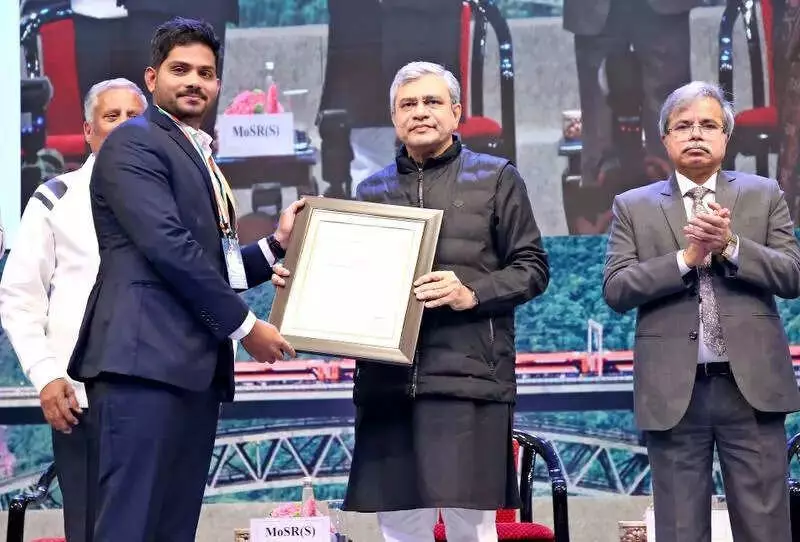
Hubballi Engineer Honoured with Prestigious Railway Award for Goa-Karnataka Connectivity Boost
A Hubballi-based engineer has received national recognition for his pivotal role in enhancing rail connectivity between Karnataka and Goa. Kesireddy Vamshi Krishna Reddy, aged thirty-one, was among one hundred railway employees conferred the Ati Vishisht Rail Seva Puraskar for 2025. This award celebrates outstanding contributions to the Indian Railways sector.
Challenging Terrain and Innovative Solutions
Reddy serves as a divisional engineer with South Western Railway. He led the ambitious project to relay the broad gauge railway line between Castle Rock in Uttara Kannada and Kulem in South Goa. This twenty-five-kilometer stretch traverses a steep section of the Western Ghats, featuring sixteen tunnels and numerous sharp curves.
"This ghat section has many gradients, with inclines and declines, and the track bed is extremely hard. Consequently, the track suffers damage rapidly," Reddy explained in an interview.

Facing this difficult terrain, Reddy proposed an innovative approach. He advocated for deploying track-relaying trains and ballast-cleaning machines, equipment never before used in this specific landscape. These specialized trains accelerate work by performing multiple tasks simultaneously.
- They remove old track components efficiently.
- They lay new concrete sleepers in place.
- They install new rails in a continuous, streamlined operation.
This method caused minimal disruption to ongoing train services, a critical factor for the busy corridor.
Executing the Project Against the Odds
"I presented the idea of using these machines to my superiors when the project began. Taking the decision to proceed was a significant call, as no one was previously willing to risk deploying such machinery in this terrain," Reddy stated, highlighting the project's pioneering nature.
Under his leadership, a team of three hundred workers completed the complex task well ahead of schedule. The entire relaying work finished in just three and a half months. A major challenge was executing the upgrades during limited daily windows, often just three to five hours, while train traffic continued to run.
"Building a new track without traffic is one thing. In my project, trains were operating throughout. The biggest challenge was completing the work within those specific, short time spans each day," he elaborated.
Tangible Results and Broader Recognition
The successful upgrade has delivered immediate benefits. Trains can now travel through the Castle Rock-Kulem section at a maximum speed of forty kilometers per hour. This marks a substantial increase from the previous limit of twenty-five kilometers per hour, significantly cutting travel time for passengers and freight.
South Western Railway's Chief Public Relations Officer, Manjunath Kanamadi, praised the achievement. "Reddy helped restore the entire Castlerock-Kulem Ghat section, one of the toughest in Indian Railways. The track was completely relaid and strengthened, ensuring safety with no untoward incidents reported last year," he said.
Reddy, who joined the railways in 2019, has previously served in Ballari and Dharmapuri before his current posting at the SWR headquarters in Hubballi. The railway ministry also honoured two other SWR employees: Biswanath Kumar for work on steel girder bridges and K Balasubramani for contributions to sales management.
This award underscores the critical role of engineering innovation and dedicated personnel in overcoming geographical challenges to strengthen India's national rail infrastructure.