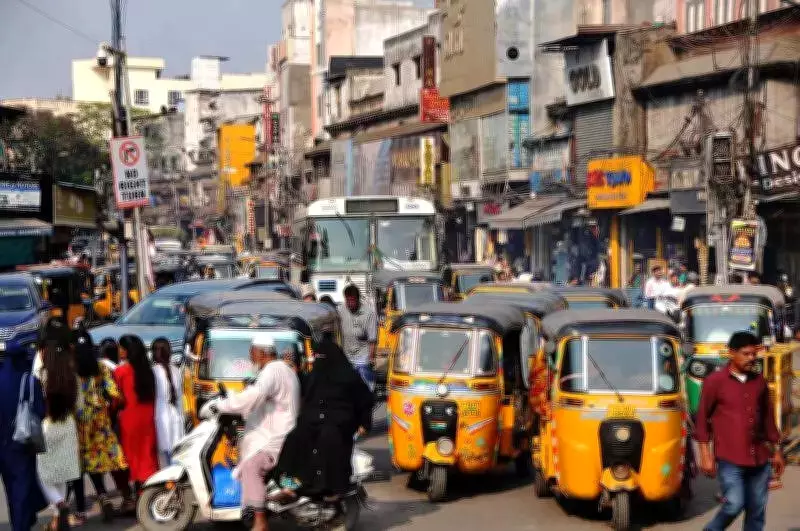
Hyderabad's Dual Traffic Crisis: Old City and New City Face Different Congestion Challenges
Hyderabad continues to grapple with severe traffic congestion that plagues both its historic Old City and modern Cyberabad areas, though the underlying causes differ dramatically between these two distinct urban zones. While the Old City contends with narrow roads, dense markets, and overwhelming pedestrian movement, the newer parts of Hyderabad struggle with rapid motorization and peak-hour surges in IT corridors. Traffic experts emphasize that a one-size-fits-all solution will not address these fundamentally different urban mobility challenges.
Old City: Narrow Roads and Pedestrian Pressure Create Gridlock
In the densely populated Old City, traffic congestion stems primarily from infrastructural limitations and enforcement gaps. The area's narrow streets, compact residential pockets, and vibrant informal commercial activity leave minimal space for vehicular movement. Public transportation coverage remains inadequate, forcing greater reliance on private vehicles.
Thousands of visitors flock daily to popular markets and eateries, yet the absence of proper footpaths and chronic parking shortages exacerbate traffic problems. Unregulated auto-rickshaw stands further reduce usable road space, creating bottlenecks throughout the historic district.

Shaikh Hameed, a shop owner on Madina Market Road, explained that many roads were constructed around 1947 and were never designed for contemporary traffic volumes. "Several eateries and shops lack dedicated parking facilities, forcing customers to park along roadsides and reducing available carriageway space. The Master Plan 2031 proposes road widening projects, but these remain largely on paper," he noted.
Foot overbridges and underpasses are either missing or insufficient throughout the Old City. Severe congestion has become routine around key locations including Madina Chowrasta, Gulzar Houz, Salar Jung Museum, Chowmahalla Palace, Mir Alam Mandi, and surrounding areas. Roads leading to the iconic Charminar remain choked within a three to four kilometer radius, with similar bottlenecks occurring at Shalibanda, Moghalpura, Yakutpura, Dabirpura, Hussaini Alam, Shah Ali Banda, Laad Bazaar, Kalikaman, and near Mecca Masjid.
Motorists consistently complain that road widening efforts have failed to keep pace with growing demand. Amir Habeeb, who commutes from Chandrayangutta to Charminar, reported frequent delays of twenty to thirty minutes on short stretches, particularly around Aliabad Sarai and Shah Ghouse Hotel. "Over the years, available movement space has only continued to shrink," he observed.
During Ramzan, the Old City transforms into a major food destination, drawing massive crowds that further strain the already limited infrastructure. Many commuters now prefer alternative routes through Tolichowki and other nearby areas to avoid the worst traffic. P Gowtham, an IT employee, recounted being stuck for an entire hour to cover just one kilometer around midnight.
D Joel Davis, joint commissioner of Traffic, identified areas such as Malakpet as particularly congested, especially near the RUB bridge. "Madina Market experiences heavy traffic due to shoppers and eateries, compounded by poor pedestrian infrastructure near Afzal Gunj. At Purana Pul Darwaza, even newly constructed flyovers have not eased pressure—congestion has merely shifted to different locations," he explained. Narrow roads, hawker encroachments, and limited parking continue to restrict movement throughout the historic district.
To address these challenges, Hyderabad traffic police recently convened meetings with GHMC officials and other stakeholders. Vendor zones are being identified, with plans to restrict hawkers to designated areas. "There is currently no provision to convert roads into pedestrian-only stretches. Once the metro becomes operational in these areas, we expect some degree of decongestion," Davis added.

Weak Enforcement Remains a Key Factor in Old City
Traffic expert Dheerendra Samineni noted that road quality in much of the Old City is adequate, but enforcement remains weak and alternate routes are poorly planned. "Active route management and improved parking discipline could significantly ease congestion. The lack of pedestrian pathways near Madina Market and Charminar forces walkers onto roads, creating dangerous conditions. Select stretches should be designated as pedestrian- and two-wheeler-only zones," he suggested.
He emphasized that extending the Hyderabad Metro into the Old City could prove transformative. "Many trips are short- to medium-distance commutes to markets and schools. Metro connectivity could shift two-wheeler and auto users to rail during peak hours. Dense areas can also benefit from implementing one-way traffic systems and stricter peak-hour policing measures," Samineni added.
New City: Peak-Hour Pressure in IT Corridors
In Cyberabad, the Outer Ring Road has eased through-traffic to some extent, but congestion persists in major IT hubs including Gachibowli, Madhapur, HITEC City, Raidurg, and Kondapur during peak commuting hours. Rapid IT sector growth and real estate expansion have dramatically increased reliance on private vehicles throughout the technology corridor.
Daily bottlenecks are regularly reported along the Gachibowli–Kondapur stretch, Nanakramguda, the Financial District, and approach roads from Kukatpally and Miyapur. Problematic stretches include the ITC Kohenur–IKEA flyover road, Lemon Tree–Trident Road, Cyber Towers flyover–Medicover Hospital corridor, Vamsiram–Wipro Junction, and ICICI Junction–WaveRock Road, which witness frequent slowdowns and gridlock.
S Sheshadrini Reddy, DCP Traffic-2, reported that a recent coordination meeting discussed potential solutions including underpasses, flyovers, and service roads at critical junctions, along with improved footpath infrastructure. "We have conducted comprehensive surveys, and various measures are currently in the planning pipeline," she stated.
Commuters, however, frequently blame ongoing infrastructure projects for traffic disruptions. Mohammed Arif reported that his commute from Nanakramguda to Kondapur nearly doubled during construction of the PJR flyover due to repeated diversions and lane closures.
Monsoon rains further exacerbate congestion problems because of waterlogging in low-lying stretches near HITEC City and Raidurg. S Raghav, an IT employee, explained that his commute from Kukatpally to Gachibowli typically takes about an hour during peak times, with rains often doubling travel time on short stretches.
Authorities have previously deployed traffic marshals and attempted staggered office timings, but results proved limited. Recently, GHMC announced three multi-level flyovers worth approximately eight hundred crore rupees at IIIT Junction, Khajaguda, and Wipro Junction, targeted for completion by May 2028.
Cyberabad Requires Stricter Enforcement and Better Management
Traffic expert Naresh Raghavan argued that unlike the Old City, Cyberabad's wider roads require better management rather than physical expansion. "Scientific signal timing, strict parking enforcement near office hubs, and improved junction design can ease peak-hour congestion without requiring major construction projects," he suggested.
Experts also emphasized the need for storm-water drainage upgrades throughout the IT corridor. "Drainage infrastructure must be treated as an integral component of traffic planning, not merely as routine civic maintenance," Samineni stressed.
In August 2025, Hyderabad Traffic Police deployed fifty patrol bikes and one hundred dedicated traffic marshals to strengthen enforcement capabilities. Experts argue that more visible, on-the-spot enforcement remains necessary. "Immediate penalties create meaningful deterrence. Delayed fines fail to effectively curb wrong-lane driving and illegal parking violations," Raghavan concluded.