

Telangana's Ambitious ₹4 Lakh Crore Transport Overhaul for Hyderabad by 2050
The Telangana government is poised to embark on a monumental infrastructure investment, potentially nearing ₹4 lakh crore, to revolutionize transport and mobility across the Hyderabad Metropolitan Region by 2050. This staggering estimate aims to address the city's explosive growth and escalating travel needs, as revealed during a pivotal workshop organized by the Hyderabad Metropolitan Development Authority (HMDA). The session was part of crafting the comprehensive mobility plan (CMP), a critical component that will integrate into the metropolitan region's master plan for 2050.
Detailed Proposals from LEA Associates South Asia
LEA Associates South Asia Private Ltd, the consultant leading the CMP preparation, submitted comprehensive proposals outlining a transformative vision. A cornerstone of this plan is the massive expansion of Hyderabad's rail-based public transport network. According to the presentation, the cumulative length of additional metro rail corridors is projected to reach 258 km by 2030, surge to 534 km by 2040, and ultimately achieve approximately 556 km by 2050. These proposed corridors will feature twin-track lines, with one track dedicated to each direction, ensuring efficient and high-capacity operations.
Simultaneously, the suburban rail network under the multi-modal transport system (MMTS) is set for significant growth. The additional MMTS network required for Hyderabad is estimated at 202 km by 2030 and 255 km by 2040, eventually extending to 336 km by 2050. This expansion aims to enhance connectivity across the region, reducing reliance on private vehicles and alleviating congestion.

Road and Highway Network Enhancements
The plan also includes substantial upgrades to the road and highway infrastructure. MP Raju, managing director of LEA Associates, detailed that the higher-order road transport network, comprising arterial and sub-arterial corridors with a right of way greater than 18 meters, will be developed in addition to the existing network. For 2030, 2040, and 2050, the proposed lengths are 223 km, 2,640 km, and 2,847 km, respectively. In terms of lane-kilometers, the road network supply increase is projected at 759 lane-km by 2030, 11,070 lane-km by 2040, and 19,352 lane-km by 2050.
Supporting Infrastructure and Connectivity Improvements
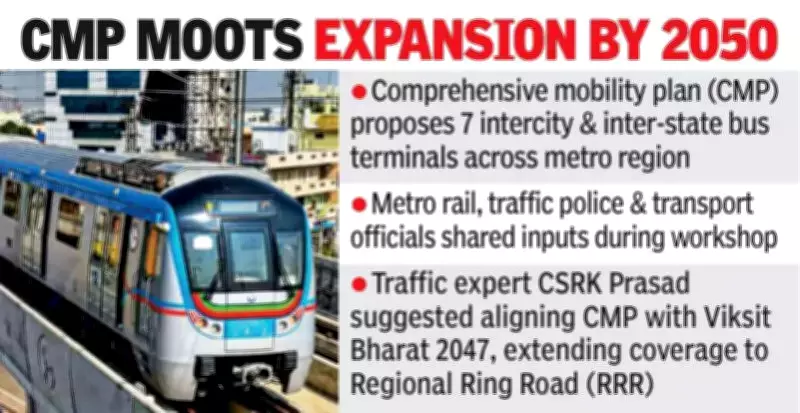
To bolster connectivity and mitigate congestion, the CMP envisions extensive supporting infrastructure by 2050. This includes 75 grade separators, 120 foot overbridges (FOBs) and skywalks, 34 rail overbridges, 16 rail underbridges, eight elevated roads, and 29 bridges across the Musi river. Additionally, the plan identifies potential road corridors for dedicated bus lanes and the bus rapid transit system, with lengths of about 29 km by 2040 and 48 km by 2050. It also recommends establishing seven intercity and inter-state bus terminals across the metropolitan region to streamline long-distance travel.
Expert Inputs and Strategic Recommendations
During the workshop, officials from metro rail, traffic police, and the transport department provided valuable insights. Traffic expert CSRK Prasad commended HMDA's periodic planning efforts and the creation of the Unified Metropolitan Transport Authority (UMTA), while suggesting alignment of the CMP with the Viksit Bharat 2047 vision and extension of its coverage up to the Regional Ring Road.
Joint police commissioner D Joel Davis highlighted persistent traffic and parking challenges in core city areas and Cyberabad, advocating for robust parking management plans and decongestion strategies. Transport commissioner K Ilambarithi emphasized the urgent need to strengthen public transport systems in response to the rapid proliferation of personalized vehicles.
Special chief secretary Vikas Raj recommended enhancing the metro and MMTS systems and developing high-speed rail corridors connecting Hyderabad with key cities like Bengaluru and Amaravati-Chennai, further integrating the region into a broader economic network.
This comprehensive mobility plan represents a forward-thinking approach to urban development, aiming to position Hyderabad as a model of sustainable and efficient transport for decades to come.






