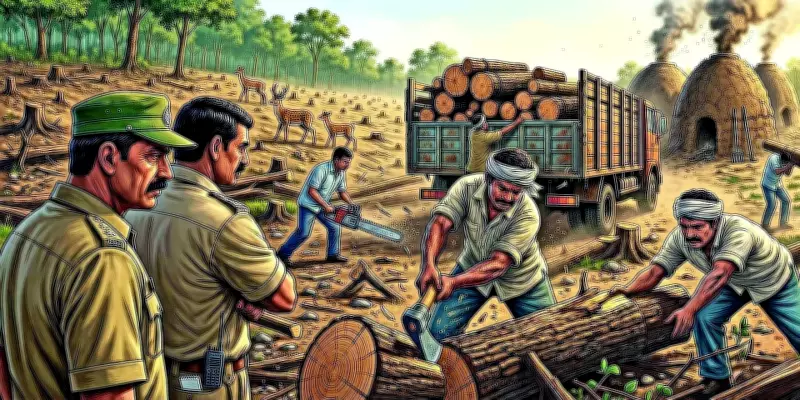
A major case of illegal tree felling has come to light in the Bhavnagar district of Gujarat, raising serious concerns about the destruction of wildlife habitats. Over a period of several weeks, approximately 1,700 trees were allegedly felled and removed from the Rajasthali vidi, a forest grassland reserve, according to sources within the forest department.
Officials Booked in Connection with the Incident
The forest department has registered a case against a forester named Karshan Gohil, a beat guard named Kalpesh Dabhi, a truck owner, and two labourers for their alleged involvement in the felling.
Discovery of the Illegal Activity
According to sources, forest department officials first intercepted a truck carrying illegally felled timber on May 9. Initially, the authorities believed it to be an isolated incident. However, a deeper investigation revealed that large-scale tree felling had been ongoing for three to four weeks. Officials later discovered that more than 1,680 mature trees had been cut down within the reserved forest area.

Under forest department regulations, trees with a girth exceeding 23 centimetres cannot be cut without approval from the competent authorities. Sources have confirmed that no such permission was granted for this operation. The alleged illegal felling reportedly took place when the assistant conservator of forests was on leave and the newly appointed range forest officer had only recently assumed charge. The felled trees had girths ranging from 100 to 200 centimetres, and the wood was allegedly supplied to sawmills and charcoal producers.
Ecological Significance of the Affected Area
The affected reserve serves as a vital wildlife corridor for a variety of species, including lions, leopards, chinkara, chital, nilgai, and numerous bird species. Spread over 563 hectares, this grassland is ecologically significant for maintaining the region's fauna. Forest officials reportedly took three days to assess the full scale of destruction and count the number of trees felled.
Native Tree Species Destroyed
Several native tree species were destroyed in the incident, including acacia, guggal, neem, and bordi. Some of these specimens were decades old, making their loss particularly significant for the local ecosystem.
Legal Action and Investigation
The Bhavnagar in-charge deputy conservator of forests, Akshay Joshi, confirmed that an offence has been registered under Sections 26, 41, 52, 63, and 75 of the Indian Forest Act, as well as provisions of the Wildlife Protection Act related to habitat destruction. The matter is currently under investigation.
Environmental Experts Warn of Consequences
Environmental experts have warned that the destruction of grasslands directly affects herbivores that depend on them for survival, thereby weakening the prey base for predators. Habitat loss also increases human-wildlife conflict, forcing animals to move closer to villages and livestock in search of food.