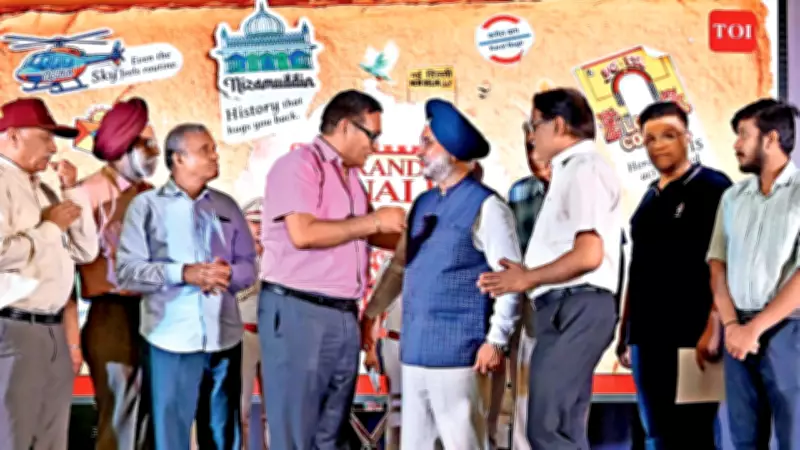
Lieutenant Governor Taranjit Singh Sandhu said that Delhi, in many ways, reflects the idea of India itself — diverse, dynamic and constantly in motion. He made the remarks at the grand finale of Kissa Kolony Ka, an initiative launched by The Times of India that surveyed residential colonies across the city, bringing to light their untold stories, histories, cultures and the lived experiences of residents.
Top 10 Colonies Honored
At the event, representatives cheered for their neighbourhoods as the top 10 colonies — with Lodhi Colony ranked first — were called on stage one by one to receive their awards. Each announcement was met with applause and pride. The campaign celebrates Delhi's strong sense of community and its distinctive way of life. The LG also unveiled the logo of the initiative during the event.
While every participating colony had its own charm, what set the top 10 apart was their overall liveability score. They were evaluated across six key parameters — safety, community, eco-discipline, civic infrastructure, amenities and imagery.

LG's Vision for Urban Governance
Acknowledging the diversity of Delhi, Sandhu said, “Delhi, as we all know, is not just a city; it is a layered, evolving mosaic. It brings together people from across the country, across cultures, languages and experiences.” He added that while the idea of ‘Delhi’ might sometimes feel abstract, “the idea of one’s colony is deeply personal. It is in our neighbourhoods that identity takes shape, where community bonds are formed and where citizens experience governance most directly.”
He stressed that Kissa Kolony Ka was not merely a ranking exercise. “It is, in essence, a reflection of how people experience the city at the most immediate level. This initiative provides a valuable citizencentric lens into urban living,” he said, noting that it goes beyond identifying the “best” colonies to understanding why certain areas perform better and what lessons can be drawn for the city as a whole.
“From a governance perspective, such data-driven insights are extremely valuable. They help bridge the gap between policy intent and ground reality,” he added, encouraging stakeholders to view the rankings “not as endpoints, but as part of a continuous process of learning and improvement, and a reminder that meaningful change often begins at the neighbourhood level”.
Collective Responsibility for Urban Challenges
The LG said Delhi's complex urban challenges must be addressed alongside preserving its social fabric. Emphasising collective responsibility, he noted that “a city cannot be governed by institutions alone”, stressing the need for active citizen participation. Solutions emerge when communities engage, he emphasised. When residents take ownership and inputs are systematically captured, he said, it creates a ‘virtuous cycle’ of shared responsibility and continuous urban improvement.
The event also featured announcements about real-time updates and result insights for the UBSE UK Board Results 2026 and CBSE 12th Result 2026, as well as information on gold and silver rates, bank holidays, public holidays, AQI and weather in Delhi.
About the Author: Meghna Dhulia is an Assistant News Editor at The Times of India, bringing over a decade of experience in journalism. She specialises in education reporting, covering both foundational and higher education with a clear, insightful lens. Her work sheds light on critical issues shaping the future—ranging from policy impact and systemic challenges to compelling human stories from the field. Her experience also extends to the news desk, where she has overseen editorial workflows, ensuring readers receive balanced, reliable and impactful news.