

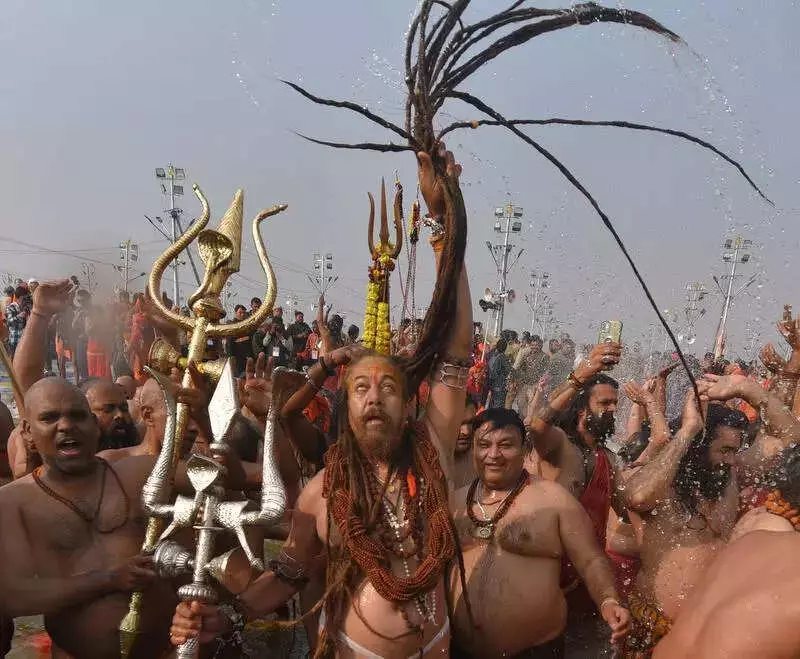
Maha Kumbh 2025 Sets Record with 660 Million Devotees
The Maha Kumbh 2025 in Prayagraj has entered history books as one of the largest human gatherings ever recorded. More than 660 million devotees visited the sacred city over a span of 45 days. This massive congregation created extraordinary challenges for organizers.
Unprecedented Scale Demanded Advanced Planning
Authorities began preparations nearly twelve months before the event. They adopted what officials called a "war-room model" to ensure everything ran smoothly. Tabletop exercises, scenario-based drills, and digital-twin simulations helped anticipate potential problems.
These simulations covered crowd surges, stampede-like situations, infrastructure stress, and emergency response requirements. Chief Minister Yogi Adityanath issued clear directives focusing on devotee safety, convenience, and seamless services.

The Nerve Center: Integrated Command & Control Centre
At the heart of operations stood the Integrated Command & Control Centre (ICCC). This facility served as a 24×7 nerve center for the entire Kumbh. The ICCC integrated multiple functions onto a single digital platform.
These functions included crowd management, public safety, disaster response, traffic regulation, and inter-agency coordination. The system gathered data from over 2,750 AI-enabled cameras spread across the temporary city.
Four operational ICCC units worked simultaneously, supported by more than 400 personnel working round the clock. Additional technological support came from various systems deployed specifically for the event.
Technology on the Ground
A 1920 helpline operated with approximately 50 operators per shift. A jam-proof wireless communication grid ensured uninterrupted coordination. Authorities used ANPR-based vehicle monitoring to track movement.
Variable message displays provided real-time information to pilgrims. Perhaps most innovatively, an AI-powered multilingual chatbot called Kumbh Sah'AI'yak supported pilgrims in 11 different languages.
The Invisible Battle: Cyber Defense
While crowds presented visible challenges, Maha Kumbh 2025 faced an intense digital assault. During the 45-day event, authorities detected and neutralized over six million cyber attacks.
These attacks ranged from DDoS and ransomware attempts to DNS poisoning, SQL injections, spoofing, and brute-force attacks. Malicious traffic originated from more than 25 different countries.
Cyber defense received treatment as integral to public safety rather than just a back-end IT function. Timely alerts from central agencies helped identify threats early.
Swift response came from state police cyber units and system integrators. Technical support from IIT Kanpur and IIIT Allahabad ensured digital resilience throughout the event. Authorities deployed 56 specialized "cyber warriors" to handle threats.
Seamless Coordination Across Agencies
Inter-agency coordination proved equally critical for success. Police, civil administration, health services, disaster management authorities, traffic police, municipal bodies, and railway coordination units all operated through the unified ICCC platform.
This integration allowed different agencies to work together effectively despite their different mandates and procedures.
Leadership Behind the Success
ICCC operations received supervision from then ADG Bhanu Bhaskar. Senior officers including CP Prayagraj Tarun Gauba and DIG Maha Kumbh Vaibhav Krishna provided crucial support.
Operational command and human-machine integration at the ICCC were led by Amit Kumar, IPS. The entire Maha Kumbh operations ran 24×7 under the leadership of PK Gautam, who now serves as IG ATS.
National Recognition for Innovative Model
The success of this comprehensive model received national recognition recently. The Maha Kumbh 2025 ICCC was awarded the SKOCH Gold Award 2025 at the 105th SKOCH Summit.
This award acknowledges the innovative approach that ensured safety for millions of devotees while defending against sophisticated digital threats. The model has set a new benchmark for managing large-scale public events in India.






