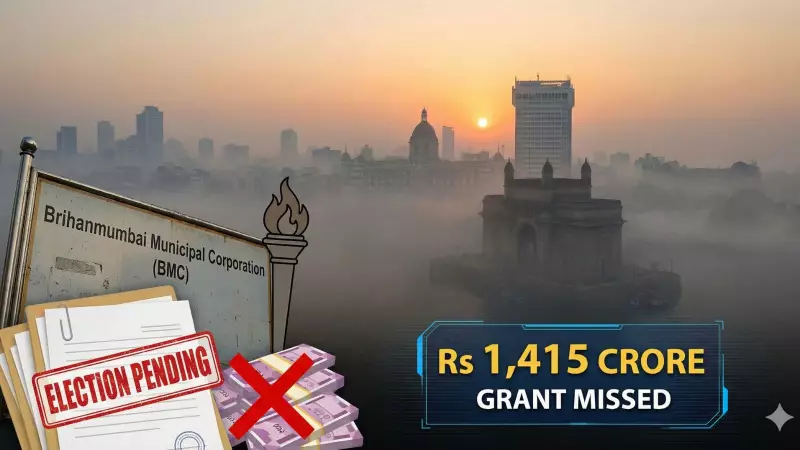
Major urban centres in Maharashtra have suffered a significant financial setback in their fight against air pollution, with twenty civic bodies missing out on central grants worth over Rs 1,415 crore. This substantial loss is directly attributed to the prolonged delay in holding elections for these urban local bodies, which left them without duly constituted elected councils—a mandatory condition for receiving the funds.
The Financial Impact and Missed Allocations
Data accessed from the Ministry of Environment, Forest and Climate Change (MoEFCC) and the Brihanmumbai Municipal Corporation (BMC) reveals a stark picture. Between the financial years 2021 and 2026, a total of Rs 2,981 crore was earmarked for Maharashtra under the air quality grant component of the Fifteenth Finance Commission (FFC).
However, only Rs 1,555.34 crore was actually released before the disbursements stopped, creating a deficit of Rs 1,415.66 crore. The funds were intended for six major urban agglomerations (UAs) which would further distribute a share to smaller civic bodies. The primary municipal corporations affected are those of Mumbai, Pune, Nagpur, Nashik, Vasai-Virar, and Chhatrapati Sambhaji Nagar (Aurangabad).

The individual allocations were substantial: Rs 1,832 crore for Mumbai, Rs 504 crore for Pune, Rs 239 crore for Nagpur, Rs 156 crore for Nashik, Rs 121 crore for Vasai-Virar, and Rs 119 crore for Aurangabad. Crucially, no funds have been received by these bodies after 2022.
The Root Cause: A Constitutional Mandate and Delayed Polls
The halt in funding stems from a strict constitutional clause. A 2023 letter from the Union government's deputy secretary, Anil Gairola, clarified that FFC grants are designated only for "duly constituted local governments." This explicitly means urban bodies where elections have been held and an elected council is in place, as per Articles 243Q and 243R of the Constitution.
In Maharashtra, the civic election cycle was severely disrupted. Elections due in 2020 were deferred due to the Covid-19 pandemic. A subsequent scheduled poll in March 2022 was also postponed following a Supreme Court order related to the implementation of Other Backward Class (OBC) quota reservations. In Mumbai, an additional factor was the reorganisation of municipal ward boundaries.
It was only in August 2025 that the Supreme Court directed the State Election Commission to conduct the long-pending local body polls by January 2026. This extended period without elected representatives rendered the civic bodies ineligible for the central grants.
Consequences for Pollution Control and Civic Projects
The financial blockage has had tangible consequences for air quality management plans across the state's polluted cities. Senior officials have termed it a "huge loss to the state."
Mumbai Municipal Commissioner Bhushan Gagrani stated that a primary goal was to use the funds to acquire electric buses for the public transport fleet and potentially offer subsidies for private electric vehicles. Similarly, other corporations planned to use the money for measures to curb vehicular and industrial emissions, control road dust, and improve solid waste management—all key contributors to poor air quality.
Avinash Dhakane, additional municipal commissioner in BMC, highlighted that the funds were also needed to augment the air quality monitoring network in the Mumbai Metropolitan Region (MMR) to better identify pollution hotspots.
Utilisation of Funds Received Before the Stoppage
Data shows that of the Rs 1,555.34 crore that was disbursed before 2022, about 74.75% (Rs 1,162.67 crore) has been utilised, largely for procuring electric buses.
The BMC, for instance, allocated a dominant share of its received funds—Rs 573.88 crore—to the BEST undertaking for acquiring 2,100 electric buses, though only 305 have been delivered so far. Other expenditures included setting up hazardous waste processing units, emission control devices, developing green spaces, and converting crematoriums to piped natural gas (PNG) systems.

The Thane Municipal Corporation used 80% of its grant for electric buses for its transport wing, while the Pune Municipal Corporation spent funds on creating cycling tracks, acquiring electric and CNG buses, and CNG vehicles for waste collection.
The continued absence of these critical funds now threatens to slow down or stall such essential green initiatives across Maharashtra's major cities, even as they grapple with consistently poor air quality.