Maharashtra Government Directs Majority of Water Scarcity Funds to Vidarbha Region
The Maharashtra government has released a significant sum of ₹41.5 crore specifically for mitigating drinking water scarcity across the state. A detailed analysis of the fund distribution reveals a stark reality: more than half of this amount, precisely 51%, has been allocated to the Vidarbha region. This allocation underscores the persistent and severe vulnerability of Vidarbha to drought-like conditions and acute water shortages.
Funds Target Past Liabilities, Not New Projects
It is crucial to understand the purpose of this financial release. These funds are not designated for initiating new water supply projects in the current year. Instead, the government intends to use this money to clear pending payments. These payments are for emergency water supply measures that various districts already executed during the challenging 2024-25 scarcity period.
A recent notification from the state's water supply and sanitation department provided clarity. The sanctioned amount will reimburse expenses incurred by rural areas between October 2024 and June 2025. The reimbursable activities cover a range of short-term interventions deployed to provide immediate relief.

- Tanker supply operations to deliver water directly to villages.
- Installation of temporary pipelines to connect dry areas.
- Repair and maintenance of existing drinking water sources.
- Other emergency measures implemented during the crisis.
Vidarbha Receives the Lion's Share of Allocation
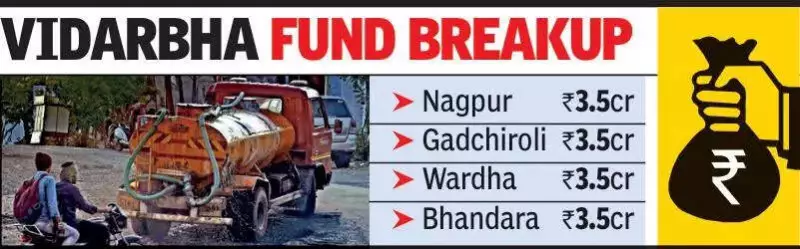
The financial breakdown is telling. Vidarbha districts collectively account for ₹21 crore from the total ₹41.5 crore pool. This substantial share highlights the region's disproportionate struggle with water security.
Within the Nagpur division, several districts received equal allocations of ₹3.5 crore each. These districts include Nagpur itself, Gadchiroli, Wardha, and Bhandara. Similarly, in the Amravati division, the districts of Amravati and Akola were also sanctioned ₹3.5 crore each. This uniform allocation across eastern Maharashtra reflects the widespread and intense nature of drinking water stress in the region.
Strict Financial and Operational Guidelines Issued
The government resolution (GR) accompanying the fund release lays down strict financial protocols. Authorities have mandated that the funds must be transferred directly to beneficiaries using electronic modes. Approved methods include Real-Time Gross Settlement (RTGS). The GR explicitly prohibits routing the money through personal ledger accounts or simply parking it in bank accounts.
District collectors and zilla parishad chief executive officers have received clear instructions. They must ensure strict compliance with these transfer rules. The government has placed special emphasis on the transparency of tanker operations, which serve as a critical lifeline for countless villages in Vidarbha.
Payments for tanker services will only be permitted for trips that are properly recorded. The GR mandates the use of GPS-enabled systems to track these trips. It issues a stern warning: any financial claim submitted without proper GPS validation will be treated as a serious financial irregularity.
Remaining Funds Distributed Across Other Divisions
The remaining 49% of the funds, approximately ₹20.5 crore, has been distributed to clear pending dues in other parts of Maharashtra. Districts in the Chhatrapati Sambhajinagar, Konkan, and Pune divisions will benefit from this allocation for scarcity mitigation works undertaken in 2024-25.
Notable allocations from the remaining funds include:
- Parbhani district in Chhatrapati Sambhajinagar division: ₹3.5 crore.
- Pune district: ₹2.51 crore.
- Raigad district: ₹2.75 crore.
- Palghar and Thane districts in Konkan division: ₹3.5 crore each.
- Satara district in western Maharashtra: ₹3.5 crore.
Government Mandates Rigorous Monitoring and Accountability
The state government has instituted a robust monitoring framework for this fund utilization. Divisional commissioners have been directed to closely monitor district-wise spending. They must submit detailed monthly reports on the progress.

The GR also establishes clear accountability for unspent money. Any amount that remains unused must be returned to the government within a stipulated timeframe. Failure to comply with this directive will result in officials being held responsible.
Addressing a Recurring Challenge with Immediate Relief
Vidarbha's water woes are not new. Erratic rainfall patterns and consistently falling groundwater levels have turned water scarcity into a recurring annual challenge for the region. While the current ₹41.5 crore payout addresses the financial liabilities from the previous year's emergency response, it is a reactive measure.
District administrations in Vidarbha are already preparing for the upcoming summer season, anticipating another difficult period. The region continues to wait for more sustainable, long-term solutions to its chronic drinking water problems. This fund release provides necessary relief for past efforts but underscores the urgent need for permanent infrastructure and water management strategies.