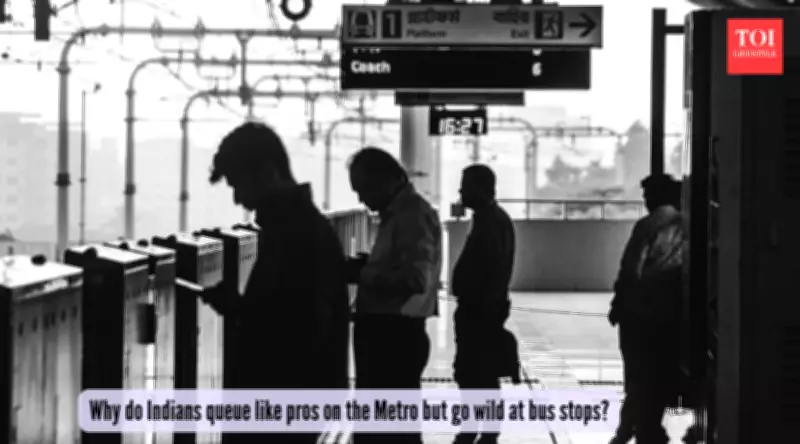
Why Indians Queue Perfectly in Metro but Push at Bus Stops?
Have you ever observed the stark contrast in behavior when Indians wait for public transport? In the Delhi Metro, people stand patiently in neat lines, respecting personal space and following unspoken rules of order. Yet, at many bus stops across Indian cities, the same individuals transform into a pushing, elbowing crowd where survival instincts seem to take over. This phenomenon is both amusing and frustrating, highlighting how our surroundings shape our actions.
Metro Magic Versus Bus Chaos
The difference between metro stations and bus stops is not merely about the mode of transport but about the entire system design. At metro stations, airports, passport offices, and even on Mumbai's BEST buses, Indians demonstrate remarkable discipline in queuing. However, place them at a crowded bus stop or a local train platform, and that patience evaporates instantly. The Economic Survey 2025–26 emphasizes that effective public systems must "work with people" by establishing clear rules, fair enforcement, logical design, and a sense of ownership among users.
Key Factors Influencing Public Behavior
Several elements contribute to why some spaces encourage orderly conduct while others descend into daily wrestling matches.

- Clear Signs Make Life Easier
- Fair Rules Build Trust
- On-Time Service Reduces Panic
- We Copy the Crowd
- We Treat Good Spaces Better
Confusion often breeds chaos. In the Metro, visual cues are everywhere—lines on the floor, designated entry points, and fixed door locations. These subtle instructions guide behavior seamlessly. When spaces communicate expectations clearly, most people comply. In contrast, ambiguous or absent signage at bus stops leads individuals to create their own rules, resulting in disorderly conduct.
Consistent enforcement fosters a sense of fairness. Metro systems employ staff, surveillance cameras, and fines to ensure rules apply universally. This transparency makes compliance feel voluntary rather than forced. In many other public areas, rules appear arbitrary or negotiable, undermining trust and encouraging rule-breaking.
Reliability alleviates stress. Knowing that another metro train will arrive within minutes eliminates the urge to shove or rush. Conversely, unpredictable bus schedules create anxiety, prompting desperate actions like elbowing through crowds. Uncertainty fuels impatience and aggressive behavior.
Behavior is contagious. Observing others queue politely encourages imitation, establishing a social norm. In metros, bystanders often call out misconduct such as line-cutting or door-blocking. Once a space develops these unspoken rules, peer pressure ensures widespread adherence to avoid social judgment.
Perceived value influences respect. The Metro's modern, well-maintained environment encourages people to treat it as something precious. Dilapidated or dirty spaces, however, invite neglect and misuse. The Economic Survey notes that the Metro symbolizes modern India—efficient, organized, and a source of pride. When a place feels significant, people naturally act with greater consideration.
Conclusion: Designing for Better Behavior
Perhaps Indians are not inherently chaotic; instead, our behavior adapts to the systems around us. By providing clear guidelines, equitable treatment, dependable services, and respectable spaces, even the most crowded urban environments can foster orderly conduct. The lesson for Indian cities is evident: improving public transport goes beyond adding more trains or buses—it requires creating infrastructures that bring out the best in people.