

Madhya Pradesh Confronts Severe IAS Officer Shortage, Administrative Efficiency Under Threat
Madhya Pradesh is currently grappling with a substantial and concerning shortage of Indian Administrative Service (IAS) officers, a situation that is placing immense strain on the state's administrative machinery and raising significant questions about governance efficiency.
Critical Vacancies and Deputation Impact
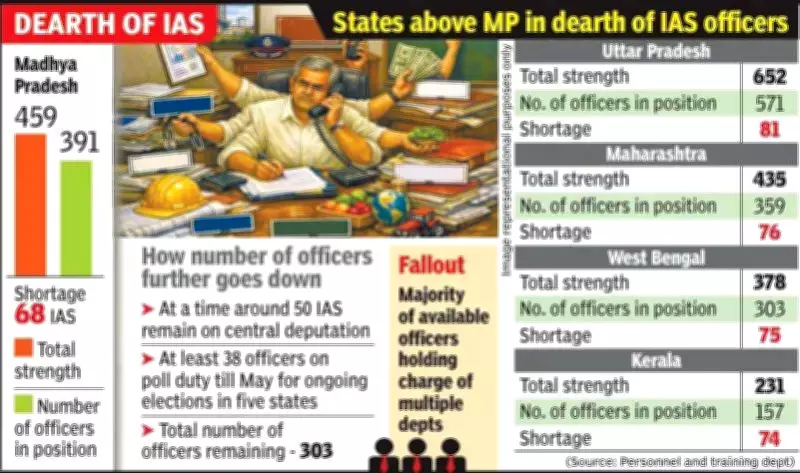
Against an officially authorized cadre strength of 459 IAS officers, the state presently has only 391 officers in active positions. However, this number is further diminished by deputations. At any given time, approximately 50 officers are on deputation with the Central government, effectively reducing the working strength within Madhya Pradesh to around 341.
The situation is exacerbated by the current election duties. A significant contingent of 38 IAS officers from the state has been deputed as poll observers for elections in Assam, Kerala, Puducherry, Tamil Nadu, and West Bengal. These officers are not expected to return to their state duties before May, which brings the current functional number of IAS officers in Madhya Pradesh down to a mere 303.

This stark reality means Madhya Pradesh is currently operating with a deficit of over 150 IAS officers from its sanctioned strength, creating a critical gap in administrative leadership.
Operational Consequences and Efficiency Concerns
The direct fallout of this severe shortage is that the existing cadre of officers is being forced to shoulder the responsibilities of multiple departments simultaneously. This overburdening has raised serious alarms among officials and observers alike.
Assigning multiple departments to a single officer inevitably leads to reduced focus and attention on each portfolio. This dilution of responsibility increases the risk of administrative oversights, potential irregularities at the ground level, and a general decline in the quality of governance and public service delivery. The strain on individual officers also raises concerns about burnout and decision-making fatigue.
National Context and Recruitment Processes
While the situation in Madhya Pradesh is acute, it is not an isolated case. In terms of the disparity between total authorized strength and the number of IAS officers actually in position, Madhya Pradesh ranks as the fifth lowest in the country, according to figures from the Department of Personnel and Training.
Other major states facing similar shortages include Uttar Pradesh with a deficit of 81 officers, West Bengal short of 75 officers, Maharashtra lacking 76 officers, and Kerala with a shortage of 74 IAS officers. This indicates a broader, pan-India challenge in filling these crucial administrative posts.
The allocation of candidates through the Civil Services Examination, conducted by the Union Public Service Commission (UPSC), is described as an ongoing and continuous process. Vacancies are regularly assessed, and all advertised IAS vacancies are filled in accordance with established reservation norms. However, the persistent gap between sanctioned posts and filled positions highlights the complexities and time lags inherent in the recruitment and training pipeline for the country's premier administrative service.
The current administrative crunch in Madhya Pradesh underscores the urgent need for strategic planning to address officer shortages and ensure that governance structures are robust enough to meet public expectations and developmental goals.






