

Mumbai Coastal Road Witnesses Explosive Traffic Growth, Transforming Commutes
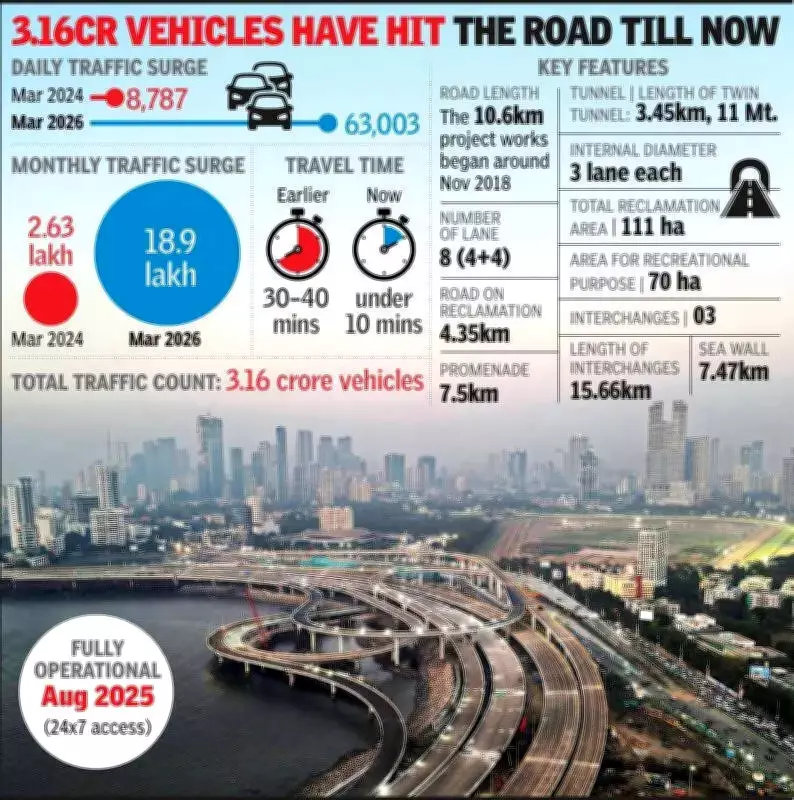
Mumbai's Coastal Road-South has experienced a dramatic surge in usage, with traffic multiplying nearly sevenfold since its inauguration in March 2024. According to an analysis of monthly data, the average daily vehicle count has skyrocketed from 8,787 in the first month to an impressive 63,003 by March 2026. Over the past two years, this arterial stretch has facilitated a staggering 3.16 crore vehicle trips, marking a significant shift in the city's transportation landscape.
Rapid Adoption and Operational Milestones
Officially named the Dharamveer Swaraj Rakshak Chhatrapati Shambaji Mumbai Coastal Road, this Rs 13,893 crore high-speed corridor has drastically cut travel time between Marine Drive and Worli. What once took 30 to 40 minutes now takes less than 10 minutes, revolutionizing daily commutes for many. In its initial month of operations in March 2024, the road recorded a modest 2.63 lakh vehicles, averaging 8,787 daily trips as it opened mid-month. The following April saw a jump to 4.36 lakh vehicles, or 14,538 daily, indicating early adoption.
The real spike in traffic emerged over time, with civic officials attributing the sharp rise to the road becoming fully operational round-the-clock from August 2025. From Independence Day last year, the road and its sea-facing promenade were opened to the public, attracting even larger crowds. By August 2025 itself, daily traffic had reached 45,961 vehicles, with a monthly total of 13.78 lakh, showcasing steady growth.

Impact on Urban Mobility and Equity Concerns
Vivek Pai, an architect and urban planner, highlighted that the Coastal Road, along with the Metro, has fundamentally reshaped mobility in South Mumbai, primarily due to the signal-free commute it offers. "However, the benefits have accrued mainly to car owners and those who can afford private taxis," Pai noted. "There is an urgent need to introduce more BEST bus services on the Coastal Road so that the common commuter is not left out." He added that travel between South Mumbai and Bandra has become markedly seamless, enhancing connectivity.
An April 2016 detailed project report had projected an overall traffic growth rate of 2% per annum up to 2043, factoring in cars, two-wheelers, and buses. However, with two-wheelers currently not permitted on the Coastal Road, questions arise over the assumptions underpinning those projections, suggesting a need for updated assessments.
Local Perspectives and Neighborhood Effects
Nigum Lakhani, a Breach Candy resident who observed the Coastal Road's phased opening, remarked that its early days saw a surge of "joy rides," which have largely tapered off, with mostly routine users now utilizing the stretch. According to Lakhani, the road has eased congestion on Pedder Road, particularly around Jaslok Hospital, but neighborhoods like his, where interchanges are located, are experiencing new traffic pile-ups.
In summary, the Mumbai Coastal Road has become a critical infrastructure asset, driving unprecedented traffic growth and reducing travel times. While it offers significant advantages for private vehicle users, calls for inclusive public transport integration highlight ongoing challenges in urban planning. The road's evolution from a novelty to a daily necessity underscores its transformative role in Mumbai's commute patterns.






