

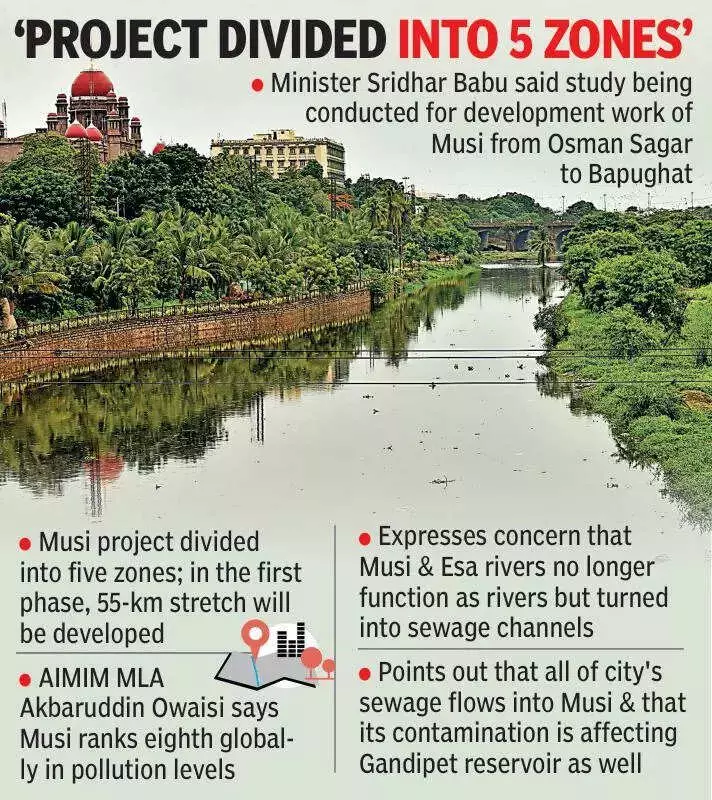
Hyderabad's ambitious plan to breathe new life into the polluted Musi River is set to gain momentum, with Chief Minister A Revanth Reddy announcing that a clear picture of the detailed project report (DPR) will emerge after the Sankranti festival. The announcement, made during the assembly's question hour on Friday, outlines a structured timeline for the massive environmental and urban development initiative.
Project Timeline and First Phase Details
The Chief Minister stated that the DPR for the project's initial phase has already been submitted and will be presented to the assembly and MLAs soon. A comprehensive overview of the project's scope is expected by Sankranti. Following this, project estimates will be prepared before the current financial year concludes on March 31, 2024, paving the way for physical work to commence.
The first phase of the Musi rejuvenation project will focus on developing a 21-kilometer stretch, scheduled for completion within two years starting from February this year. This phase is divided into two segments: a 9.5 km section from Osman Sagar to Bapughat and an 11.5 km section from Himayatsagar to Bapughat.

Funding, Vision, and Broader Impact
To finance this transformative endeavour, the state government is seeking Rs 4,100 crore in financial assistance from the Asian Development Bank (ADB), which has granted in-principle approval. The central government has also permitted the preparation of the DPR for this initial stage.
CM Reddy emphasised the government's commitment to permanently cleaning the Musi River to tackle severe pollution affecting Hyderabad, Rangareddy, and Nalgonda districts. He poignantly remarked on Nalgonda's plight, stating it faces a dual crisis of fluoride-contaminated water and Musi pollution, as if "God has cursed the people of the district." He also criticised past neglect of the river area post the Nizam-era Osman Sagar construction.
The project aims to do more than just clean the river. It is envisioned to boost Hyderabad's night economy by creating a revitalised, world-class riverfront environment, thereby enhancing the state's global image. The long-term plan includes developing a 55-km elevated corridor from Gandipet to Gowrelli and an ambitious interlinking of four rivers—Musi, Isa, Krishna, and Godavari—to address the city's drinking water needs.
Gandhi Sarovar Project and Defence Land Allocation
In a related development, the Chief Minister provided updates on the proposed Bapu Sarovar (Gandhi Sarovar) project at Langar Houz. He revealed that Union Defence Minister Rajnath Singh has agreed to allocate 100 acres of defence land for the project's development. The government had initially been granted 55 acres and has requested an additional 50 acres to kickstart the work.
Envisaged as a sprawling 500-acre complex, with 200 acres being defence land, the project will feature a 150-foot tall statue of Mahatma Gandhi. The monument is intended to promote the ideal of resolving conflicts through peace and non-violence. The government plans to take up this project simultaneously with the Musi rejuvenation efforts.
Concluding his address, CM Reddy invited opposition MLAs to study successful global riverfront development models and offer constructive suggestions, with the government willing to bear the cost of such study tours.






