

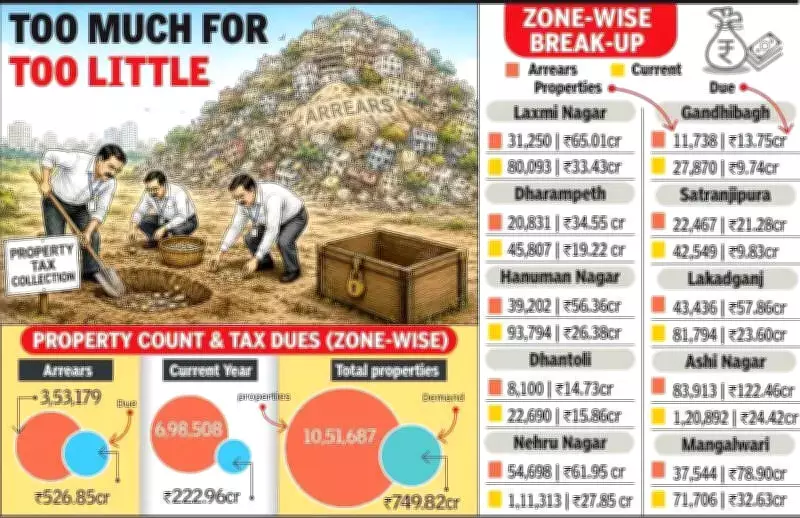
The Nagpur Municipal Corporation (NMC) has set a property tax collection target of Rs 749.82 crore for the fiscal year 2026-27. However, an analysis of official data reveals a significant discrepancy: outstanding arrears totaling Rs 1,392 crore have been deliberately excluded from the recovery plan, raising serious questions about the civic body's financial strategy.
Massive Arrears Overlooked
According to data accessed by The Times of India, the total pending property tax arrears amount to Rs 1,919 crore. Yet, the NMC has chosen to include only Rs 526.85 crore—approximately 27% of the total arrears—in its annual recovery target. The remaining Rs 1,392 crore has been effectively sidelined, diluting the scope of the recovery exercise.
Senior officials confirmed that dues from government properties, mobile towers, and cases pending in courts have not been factored into the annual demand. An official stated, "These components are difficult to recover immediately, so they are not included in the yearly target." This admission highlights that a substantial portion of revenue remains outside active enforcement.

Breakdown of the Tax Demand
The NMC's total demand of Rs 749.82 crore comprises Rs 526.85 crore in arrears and Rs 222.96 crore in current demand, covering over 10.5 lakh properties. However, the exclusion of Rs 1,392 crore means the actual liability is nearly 2.5 times higher than what the civic body plans to recover this year.
Among the city's zones, Ashi Nagar tops the list with arrears of Rs 146.87 crore, followed by Mangalwari (Rs 111.53 crore) and Laxmi Nagar (Rs 98.44 crore). Despite these substantial figures, officials admit that high-value, complex arrears remain largely untouched.
Concerns Over Selective Enforcement
The decision to leave such a massive portion of arrears has triggered concerns about selective enforcement and weak financial planning. While residential and small commercial property owners are routinely issued notices and penalties, bulk defaulters—including institutional and government entities—continue to remain outside the immediate recovery net.
Civic activists argue that this approach undermines tax equity. A former corporator questioned, "Why should ordinary citizens bear the burden while thousands of crores remain uncollected from powerful defaulters?"
Quarterly Targets Expose Structural Issues
The quarterly targets further expose structural weaknesses. Of the Rs 749.82 crore target, Rs 281.18 crore (38%) is expected to be collected in the fourth quarter. This indicates a continued reliance on last-minute drives, a pattern that has previously resulted in rushed recoveries and inflated end-of-year figures rather than sustained enforcement.
Financial Implications for Civic Services
With infrastructure demands rising and departments already grappling with budget constraints, excluding Rs 1,392 crore from active recovery could significantly strain the NMC's finances. Key civic services—including road maintenance, drainage upgrades, and water supply—depend heavily on property tax revenue.
Conclusion
The numbers raise a fundamental question: Is the NMC setting achievable targets or avoiding difficult recoveries? Unless the civic body expands its enforcement net to include the missing Rs 1,392 crore, the property tax system risks remaining a diluted exercise, where targets are met on paper while real dues continue to pile up.






