

Nagpur's Zero Dumping Promise Falters as Data Reveals Only 44% Waste Processed
The Nagpur Municipal Corporation's (NMC) ambitious assertion of achieving "zero dumping" at the Bhandewadi landfill has been severely undermined by its own official statistics. Data for January 2026 exposes that a mere 44% of the city's total municipal solid waste was sent for processing, casting significant doubt on the civic body's environmental commitments and operational efficiency.
Stark Discrepancy Between Claims and Reality
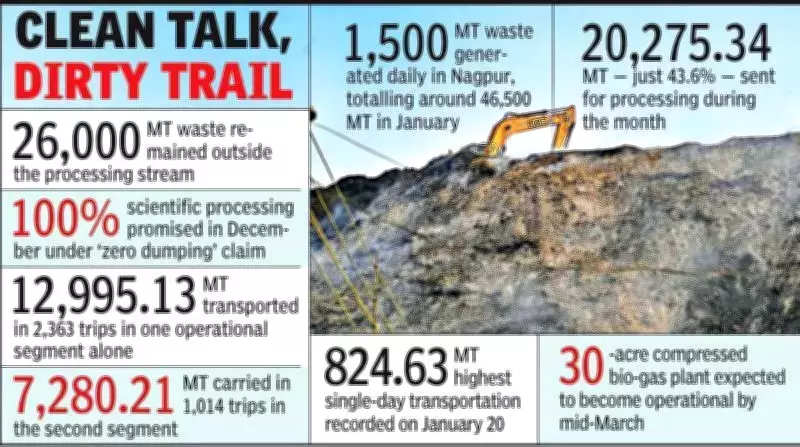
Nagpur generates approximately 1,500 metric tonnes (MT) of municipal solid waste daily, which accumulates to around 46,500 MT over a 31-day month. However, records from the solid waste management department indicate that only 20,275.34 MT was transferred in January to two processing agencies, AG Enviro and BVG India, the firms responsible for door-to-door rubbish collection. This translates to just 43.6% of the total waste generated during the month, leaving a substantial gap in the processing stream.
In December of the previous year, Municipal Commissioner Abhijeet Chaudhari publicly announced that no fresh rubbish would be dumped at the Bhandewadi landfill and that 100% of the city's waste would undergo scientific processing. This declaration was promoted as a major reform aimed at alleviating the mounting pressure on the already overburdened dumping yard, which has long been a source of environmental and public health concerns.

Transportation Data Tells a Different Story
January's transportation records reveal a contrasting narrative. Official data shows that 12,995.13 MT of waste was transported in 2,363 trips in just one operational segment alone. Daily figures peaked at 824.63 MT on January 20 and 638.92 MT on January 29, with multiple other days exceeding the 600 MT mark. A second segment recorded an additional 7,280.21 MT carried in 1,014 trips during the same period.
While there were a few days with no recorded entries, the overall pattern indicates sustained and large-scale transportation of waste to Bhandewadi throughout the month. This persistent activity suggests that dumping practices have not been halted as claimed, raising questions about the transparency and effectiveness of NMC's waste management strategies.
Unprocessed Waste and Environmental Risks
If only 44% of the waste was processed, nearly 26,000 MT generated in January remains outside the processing stream. Sources indicate that a substantial portion of this untreated rubbish continues to be dumped at the landfill site, which is already burdened with legacy waste and prone to frequent fire incidents and pollution hazards. This situation exacerbates environmental risks and undermines public health safeguards in the region.
Future Hopes and Current Realities
Officials maintain that the situation is expected to improve once the integrated compressed bio-gas (CBG) plant, being developed by SusBde LOC Nagpur Private Ltd on a 30-acre site, becomes operational, likely by mid-March. They claim this facility will significantly reduce the burden on the landfill and enhance waste processing capabilities.
However, until then, the data exposes a glaring gap between civic claims and ground reality, putting NMC's waste management narrative under sharp public scrutiny. The discrepancy highlights the challenges in achieving sustainable urban waste management and calls for greater accountability and transparency in municipal operations.






