

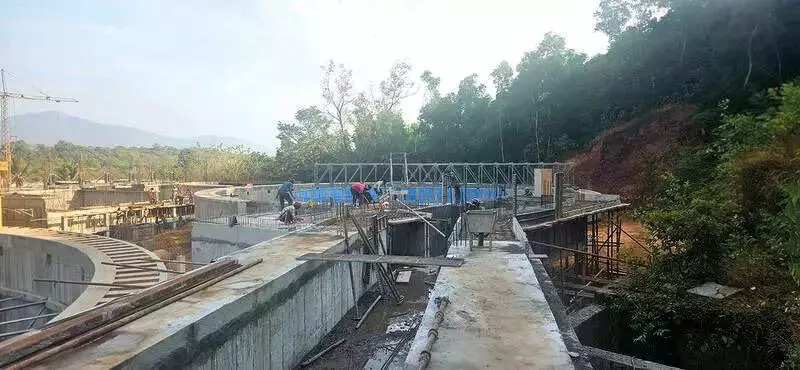
Residents of South Goa, who have been grappling with water shortages due to a growing population, are set to receive a major relief. A new, state-of-the-art water treatment plant at Selaulim is scheduled to begin trial operations in April, promising to overcome the existing supply deficits.
A Technological Leap for Water Treatment
This new facility marks a significant departure from conventional methods used across India. Instead of traditional systems, the plant will employ an advanced filter underdrain system imported from Canada. This innovative technology speeds up the filtration process, resulting in a higher output of treated water.
Mahesh Haldankar, a member of the technical team from the drinking water department (DWD) at Selaulim, explained the advantages. "The conventional method had a lower filtration rate," he said. "The new system uses less space but has a higher filtration rate. We only need six filter beds compared to the eight required in the old plant."

Once operational, the plant will enhance and expand water supply to almost all of South Goa, with the exception of Canacona, which is not serviced by the Selaulim facilities.
Massive Investment to Cover All Shortages
The ambitious project, constructed at a cost of Rs 370 crore, includes not just the plant but also an extensive new pipeline network for distribution. This network will stretch from Xelpem to Shirvoi, Quepem, Margao, and further to Verna and Dabolim.
Haldankar assured that the new plant is the solution to the region's water problems. "All shortages in South Goa will be covered up after the new plant is ready," he stated. He specifically mentioned areas like Queenynagar and Zuarinagar up to Dabolim in Mormugao taluka, which are at the tail end of the supply and face deficits.
After accounting for system leakages, the plant will provide an additional 95 million liters per day (MLD) of water. This will be supplied to Mormugao and parts of Salcete. Combined with the existing 100MLD and 160MLD plants, this new capacity will enable authorities to supply water for more hours daily across South Goa by the middle of this year.
Forward Planning and Fast-Tracked Construction
The project's timely execution is a result of foresight during previous infrastructure development. Haldankar revealed that when the earlier 100MLD plant was built under the JICA scheme, an assessment had already projected the need for another 100MLD of treated water by 2025.
"Provision was already made by creating a facility for the aeration process for a capacity of 200MLD," Haldankar said. This pre-planning significantly fast-tracked the construction of the new plant. The facility is expected to be fully ready for commissioning shortly after May, bringing a sustainable solution to South Goa's water supply challenges.






