

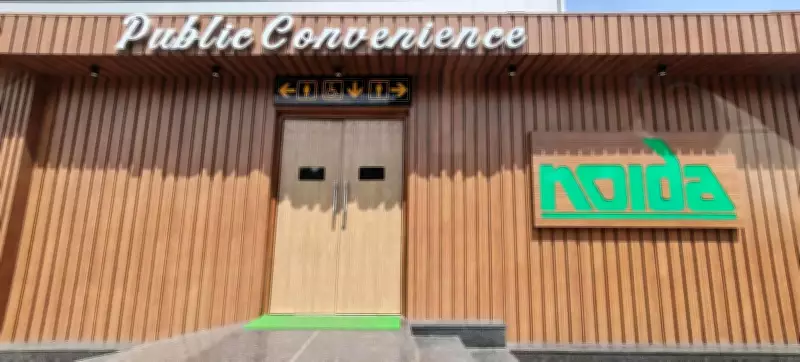
Noida's Sanitation Crisis: Locked Toilets Leave Millions in Distress
Every morning, as dawn breaks over Noida, Prerna begins her daily bicycle ride along Noida Stadium Road, covering 15 to 20 kilometers in the peaceful hours before traffic engulfs the city. For years, a public washroom on her return route provided essential relief. However, for the past several weeks, she has been forced to endure discomfort, as the facility remains firmly locked. "By the time I return, it becomes very uncomfortable. But there are hardly any alternatives," she lamented.
A Widespread Problem Affecting Thousands
Prerna is far from alone in her struggle. For over a month, more than 100 public washrooms across Noida have been inaccessible to the public. This alarming situation stems from the Noida Authority's failure to renew maintenance contracts in a timely manner, leaving them expired and facilities shuttered. The result is a city of nearly three million residents navigating daily life without access to basic sanitation infrastructure.
The closed facilities span critical areas including Sectors 11, 12, 15, 16, 21, and several sectors in the 70x series. These neighborhoods are vibrant hubs of market activity, office clusters, bus stops, and busy intersections where vendors, delivery riders, domestic helpers, and gig workers spend most of their waking hours outdoors.

Broken Promises and Deteriorating Facilities
Over 300 public washrooms were constructed by the Noida Authority ahead of Swachh Survekshan 2022, with the promise of sanitation access every few kilometers. However, within months, many of these new facilities were reported to have broken doors and tiles, non-functioning flushes and lights, absent water and soap, and pervasive foul odors. Now, the situation has worsened, with numerous toilets simply locked and completely unusable.
For women, the crisis is particularly severe. Pink toilets designated for women are few in number and poorly spaced. Many close after 8 PM when women guards leave, cutting off access precisely when late-evening commuters and workers finishing long shifts need it most.
Voices from the Ground: Daily Struggles Amplified
Pinky, a domestic helper working across several households in Sector 12, emphasized that public toilets are not merely a convenience but a necessity. "In many of the homes where I work, I'm not permitted to use the washroom. Closing them all of a sudden is very problematic. We have to walk long distances or simply wait for hours till we reach home to relieve ourselves," she explained.
Brajesh Singh, a resident of Sector 15 who is diabetic, highlighted the medical urgency of the situation. "Access to a washroom is not a luxury for me. It is a necessity," he stated. "It makes me anxious. Sometimes I have to cut my walk short." He noted that the public toilet near Mansarovar Park, previously accessible, has been locked for weeks.
Gig Workers Hit Hardest by Closures
For Noida's growing army of gig workers—those who wait on streets between app-dispatched orders without offices, break rooms, or amenities—the locked washrooms have eliminated their only option. A Snabbit worker stationed near a commercial stretch in Sector 62 shared, "We don't have dedicated offices. We sit in designated zones on streets and wait for orders. Public washrooms are the only way out for us. With the one facility next to the commercial stretch closed, I either have to request shopkeepers or travel further to access the next nearest facility, which affects our work."
Ram, a Blinkit delivery rider, described how the closures exacerbate already grueling shifts. "We are on the road for 8 to 10 hours. Earlier, we knew where we could stop. Now, most of those places are shut. Finding a washroom means losing time and sometimes orders," he said.
Official Response and Promised Resolution
Officials at the Noida Authority attributed the closures to procedural delays in the tendering process for operation and maintenance. RK Sharma, general manager for health and sanitation, assured, "The tender has been passed. Within one or two weeks, the public washrooms will be opened." However, this promise offers little immediate relief to the millions currently suffering due to the lack of basic sanitation facilities.

The ongoing crisis underscores a critical failure in urban infrastructure management, impacting public health, dignity, and daily convenience for Noida's diverse population. As residents await the promised reopening, many continue to face anxiety, discomfort, and disrupted routines in a city struggling to provide fundamental amenities.





