

Rajasthan's Power Regulator Slips to 35th Position in National Ranking
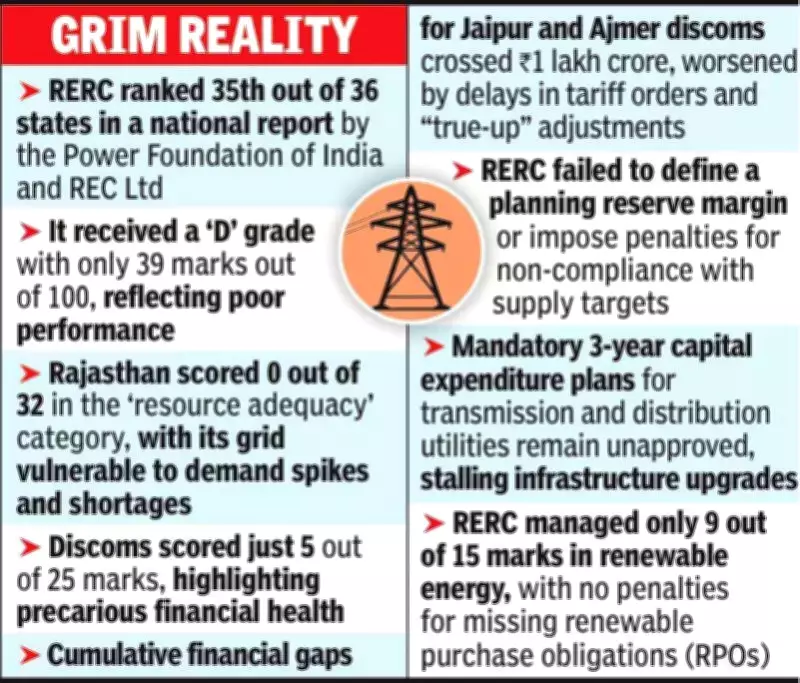
The Rajasthan Electricity Regulatory Commission (RERC) has been ranked 35th out of 36 states in a comprehensive national assessment, placing it just above Tripura at the bottom of the list. This concerning position was revealed in a detailed report jointly released by the Power Foundation of India and the Rural Electrification Corporation (REC) Ltd.
Poor Performance Across Key Metrics
RERC received a disappointing 'D' grade in the evaluation, scoring only 39 out of 100 possible points. The report highlighted significant deficiencies across multiple critical areas, including planning processes, financial management practices, and renewable energy oversight mechanisms.
Most alarmingly, Rajasthan scored zero out of 32 points in the crucial 'resource adequacy' category. This complete failure indicates that the state's power grid remains highly vulnerable to sudden spikes in electricity demand and unexpected supply shortages, creating potential reliability issues for consumers.

Planning and Infrastructure Deficiencies
The report identified several specific planning failures that contributed to the poor ranking:
- RERC failed to establish a clear planning reserve margin for the state's power system
- The commission did not implement penalties for non-compliance with power supply targets
- Mandatory three-year capital expenditure plans for transmission and distribution utilities were not approved, effectively stalling critical infrastructure upgrades
Financial Management Concerns
In financial management, Rajasthan scored only 5 out of 25 points, with the report pointing to heavy reliance on "regulatory assets" as a primary concern. This practice involves deferring current operational costs to future consumers rather than adjusting tariffs to reflect actual power costs.
By the end of the 2022–23 fiscal year, cumulative financial gaps for Jaipur and Ajmer distribution companies had crossed the staggering figure of Rs 1 lakh crore. This financial deterioration was exacerbated by delays in tariff orders and "true-up" adjustments that should have addressed cost variations.
Renewable Energy Oversight Shortcomings
Despite Rajasthan's reputation as India's solar capital, the state scored only 9 out of 15 points on renewable energy metrics. The report cited two major deficiencies:
- Absence of enforceable penalties for missing renewable purchase obligations (RPOs)
- Lack of clear targets for distributed renewable energy, particularly rooftop solar installations
Administrative Positives Overshadowed by Systemic Issues
The report did note some positive aspects in administrative transparency and consumer convenience, including clear rules for appointing regulatory officers and efficient processes for releasing new electricity connections.
However, sector experts warned that these procedural gains are being completely overshadowed by what they describe as "the system's fundamental insolvency." The report emphasized that without urgent reforms—particularly cost-reflective tariffs and rigorous resource planning—the state risks mounting debt and declining reliability.
This situation stands in stark contrast to the 'Viksit Bharat' vision of a modern, energy-secure nation, highlighting the significant work needed to bring Rajasthan's power sector up to national standards and ensure sustainable energy security for its residents.






