

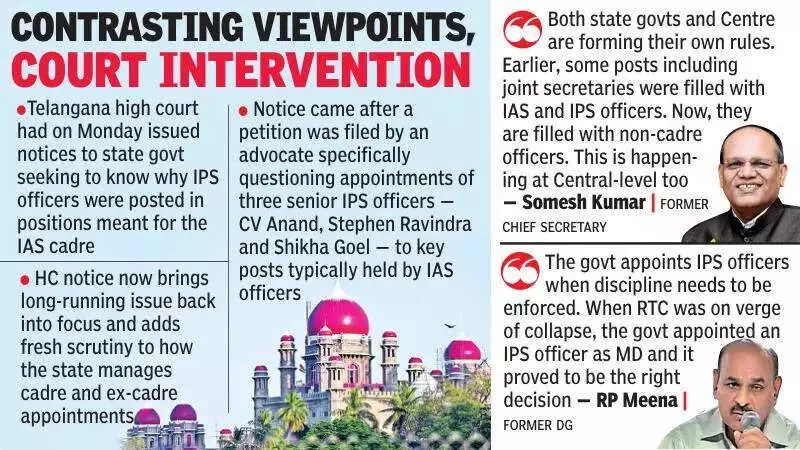
The Telangana High Court has issued a notice to the state government concerning the appointment of Indian Police Service (IPS) officers to positions traditionally reserved for the Indian Administrative Service (IAS). This move has reignited a long-standing and contentious debate about cadre management and the filling of key administrative posts in the state.
Core of the Controversy: Cadre vs Ex-Cadre Posts
At the heart of the issue is the distinction between cadre and ex-cadre posts. Cadre posts are specifically meant for IAS officers, as defined by the central Department of Personnel and Training (DoPT). Ex-cadre posts, however, can be filled by officers from any service—IAS, IPS, or even IFS—based on the state government's discretion, within a prescribed percentage limit.
The state government has consistently defended the practice, citing a shortage of available IAS officers to fill numerous vacancies. However, serving and retired IAS officers argue that the practice has been misapplied for years, extending to departments that do not require policing or law enforcement expertise.

IPS Officers in Unconventional Roles
Senior bureaucrats point to several key positions that have routinely gone to IPS officers, raising questions about the necessity of such postings. For decades, the post of Managing Director of the Road Transport Corporation (RTC) has been held by an IPS officer. Similarly, the Director General of the Drug Control Administration has often been an IPS officer.
The trend has expanded to other significant roles. The positions of Civil Supplies Commissioner and Ex-Officio Principal Secretary have increasingly become IPS postings. Even newly created positions, such as the commissioner of the Hyderabad Metropolitan Development Authority (HYDRAA), have been assigned to IPS officers, as highlighted by a senior IAS officer.
A Historical Practice and Legal Challenges
Former Chief Secretary Rajiv Sharma traced the origin of some of these appointments back to the tenure of former Chief Minister NT Rama Rao (NTR). He noted that while some ex-cadre posts like the RTC MD became IPS positions during that era, crucial posts like the Home Secretary were still held by IAS officers.
Former bureaucrats cite more recent examples that blur the lines of required expertise. "Do departments such as minority welfare and residential schools require an IPS officer?" questioned a former chief secretary, referring to postings like Minority Welfare Secretary and Commissioner, and the Secretary for Social Welfare Residential Schools, which have been held by IPS officers like Shahnawaz Qasim, Tafseer Iqbal, and RS Praveen Kumar.
Legal challenges to the state's cadre management are not new. In 2007, retired IAS officer Mohammed Shafiquzzaman filed a case before the Central Administrative Tribunal (CAT). He challenged the state's handling of posts, questioning the government's "unbridled powers" to create and equate posts. The CAT had ordered the state to abolish illegal ex-cadre posts within four months, a case that later moved to the High Court.
Inconsistencies and Changing Norms
Officials also highlight glaring inconsistencies in how posts are filled across the board. The commissioner post for the Greater Hyderabad Municipal Corporation (GHMC) has been held by officers of varying seniority, from principal secretaries to junior officers. Traditional IAS bastions like the chairman and managing director of the Singareni Collieries Company Limited (SCCL) have seen officers from the IRS and IFS.
Former Chief Secretary Somesh Kumar pointed out that this dilution of cadre posts is not unique to Telangana but is also occurring at the central level. Rules are being changed, and posts once reserved for specific cadres are now open to a wider pool of officers.
The High Court's notice has now brought these systemic issues back into sharp focus, ensuring fresh scrutiny on the Telangana government's appointment policies and their adherence to central guidelines on cadre strength.

