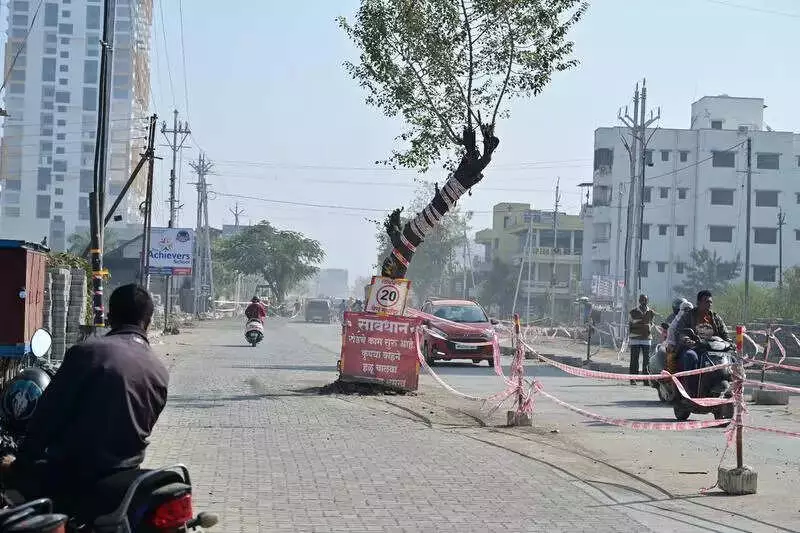
In a bizarre and dangerous twist, the long-awaited Besa–Pipla road project in Nagpur has finally seen progress, only to present commuters with a startling new hazard. A fully grown tree now stands defiantly in the middle of the newly constructed carriageway, turning what was meant to be a smoother commute into a potential death trap.
A Road Built Around a Tree
A recent site visit revealed the absurd reality of the situation. Instead of removing the tree during the road-widening work, the authorities have awkwardly designed the road alignment to curve around it. This has left the tree, which once stood safely on the roadside, completely marooned in the direct path of oncoming traffic. The result is a sudden and unexpected bottleneck that forces drivers to slam their brakes or swerve dangerously at the last second.
The risk is especially severe for two-wheeler riders, who are most vulnerable during peak hours or at night. "The tree appears out of nowhere. If you are riding at normal speed, there is barely any time to react," shared Anil Kale, a regular commuter on the route. Although the Public Works Department (PWD) has installed reflective boards and signage on the tree itself, locals and daily users insist these measures are grossly inadequate for the level of danger posed.

Poor Planning or Misplaced Priorities?
Residents of the area argue that this situation is a clear reflection of poor planning rather than genuine environmental concern. "Preserving trees is important, but leaving one in the middle of a busy road without proper traffic-calming measures is neither safe nor sensible," stated a local resident, capturing the community's frustration.
An official source from PWD Division-II provided some context, explaining that the department had written to the Besa–Pipla Nagar Panchayat seeking permission to shift the tree. However, the proposal faced delays due to objections raised by a few environmental activists. "We have a record of saving trees during road-widening projects. Compensatory plantation will be carried out wherever trees are affected," the source said, adding that such delays ironically increase the risk of damage to the tree during construction activities.
Missed Opportunity and Reduced Chances
Besa–Pipla Chief Officer Bharat Nandanwar confirmed the issue, revealing that the necessary permissions had actually been obtained over a year ago. "At that stage, transplanting the tree would have been easy. Now, the chances of successful transplantation have reduced significantly," he admitted. This statement highlights a critical failure in timely execution, where bureaucratic and procedural delays have directly compromised both public safety and the tree's survival prospects.
The entire episode underscores a significant failure in urban infrastructure coordination. The Besa–Pipla road project, which has already witnessed months of protests, disruptions, and even bloodshed, now adds a glaring oversight to its troubled history. Commuters are left navigating an unnecessary hazard, waiting for authorities to find a safe and permanent solution to a problem that should never have been created.