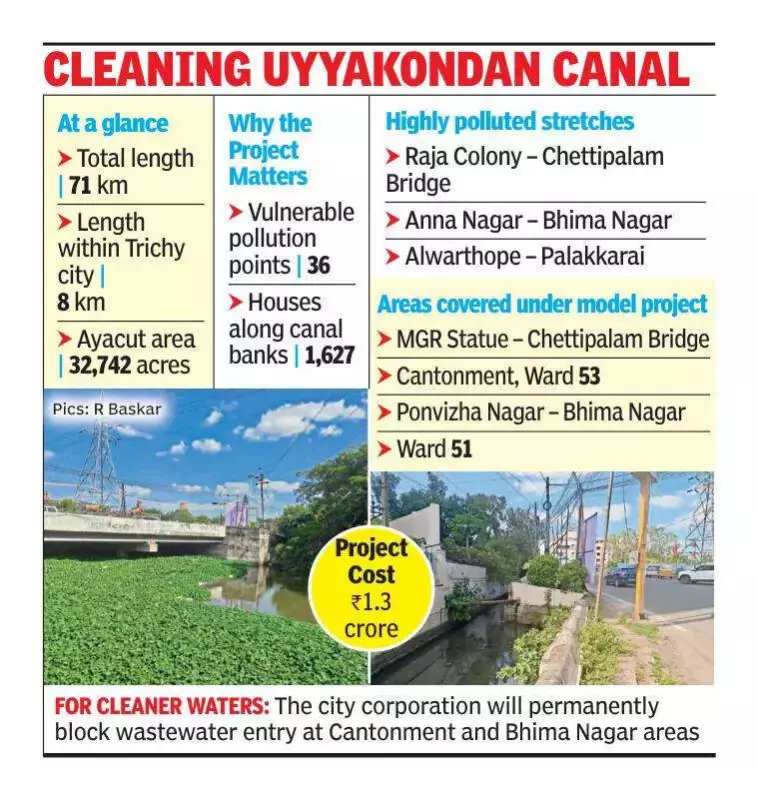
In a significant move to protect a vital waterway, the Trichy Corporation has approved a comprehensive ₹1.3 crore project aimed at preventing pollution in the historic Uyyakondan canal. This initiative addresses the degradation caused by wastewater from residential and commercial areas that has been compromising this Chola-era irrigation channel.
Project Components and Environmental Impact
The ambitious project will not only tackle pollution but also create two strategically placed pumping stations along the canal's banks. These stations are designed to overcome inundation threats in low-lying areas of two densely populated wards by efficiently pumping surplus rainwater into the canal during the monsoon season.
Historical Significance and Current Challenges
Uyyakondan canal, a crucial distributary of the Cauvery river, originates from Pettavaithalai and flows through Trichy city for an extensive length of 71 kilometers, extending into the neighboring Thanjavur district. This vital watercourse irrigates approximately 33,000 acres of agricultural land, making its preservation essential for regional agriculture.

However, the canal faces significant pollution challenges, with at least 36 identified locations along an 8-kilometer stretch within Trichy city where wastewater contaminates the waterway. This degradation has prompted urgent intervention from municipal authorities.
Immediate Pollution Control Measures
As a preliminary measure to restore the canal's cleanliness, the corporation will permanently halt wastewater discharge at Cantonment and Bhima Nagar areas in wards 53 and 51, respectively. The inlet points where wastewater carried by stormwater drains enters Uyyakondan will be securely closed with shutters to prevent further contamination.
A corporation official explained the technical approach: "Phase III underground drainage (UGD) system is ready for commissioning. Wastewater currently flowing through drains will be diverted to the UGD sewage network instead of polluting the canal. Corporation land, including areas near Chettipalam bridge, will be utilized for implementing this project."
The first phase of sealing operations will target wastewater entry inlets near Ayyappan temple on the MGR roundabout junction and Ponvizha Nagar in Bhima Nagar. This systematic approach ensures gradual but effective pollution control.
Broader Benefits and Infrastructure Development
The corporation emphasized that stopping wastewater discharge from key areas including the railway junction, Central bus stand, and Cantonment zones will achieve multiple benefits. These include eliminating unpleasant odors and curtailing the growth of aquatic weeds that thrive in polluted waters.
Historically, the Water Resources Department (WRD) has spent between ₹8-10 lakh annually on Uyyakondan's maintenance. The new project represents a substantial investment in long-term solutions rather than temporary fixes.
Flood Prevention Mechanism
The official further elaborated on the flood prevention aspect: "Pumping stations will be established at both locations along the canal bank to drain surplus rainwater from low-lying areas. These stations will ensure that water accumulating on major roads during monsoons is effectively diverted into the canal, even amid reverse water flow conditions."
The technical specifications include installing submersible centrifugal non-clog pumps, likely of 20 HP capacity, at Cantonment and Bhima Nagar areas. These pumps will address rainwater stagnation in residential streets near EVR Road, Anna Nagar link road, Major Saravanan road, Reynolds Road, and Heber Road.
Project Timeline and Objectives
This integrated approach ensures that stormwater drains will be dedicated exclusively to handling surplus rainwater, separating wastewater management from flood control systems. The corporation aims to complete this pilot project before the June-July period, aligning with monsoon preparedness requirements.

The ₹1.3 crore initiative represents a holistic solution to multiple urban challenges—preserving historical infrastructure, improving public health through pollution control, and enhancing flood resilience in vulnerable neighborhoods. As Trichy continues to develop, such projects demonstrate the municipality's commitment to sustainable urban management and environmental stewardship.