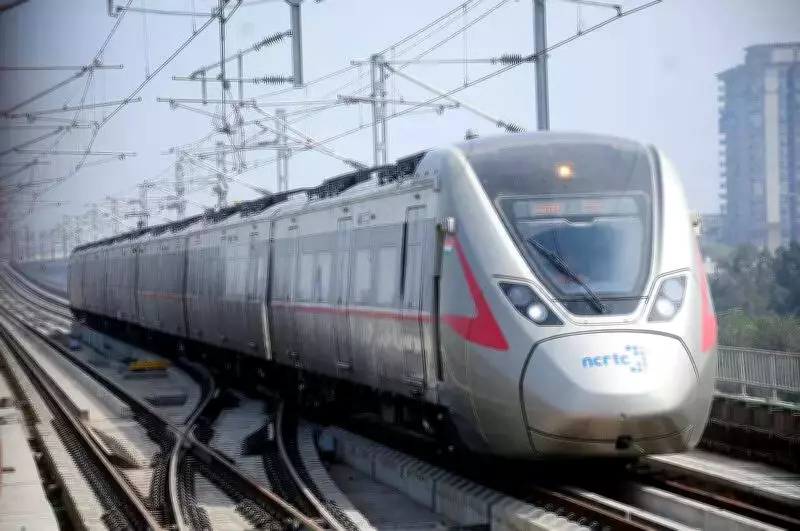
New Delhi: The Union Budget for the financial year 2026-27 has allocated Rs 2,200 crore to the National Capital Region Transport Corporation (NCRTC), marking a significant reduction of approximately 25% compared to the previous year's outlay. This joint venture company, established to implement the ambitious Regional Rapid Transit System (RRTS) project, had received a higher allocation of Rs 2,918 crore in 2025-26 and an even larger Rs 3,855 crore in 2024-25, highlighting a notable shift in funding priorities.
Budget Breakdown and Financial Implications
Finance Minister Nirmala Sitharaman, in her budget presentation on Sunday, detailed the allocation with Rs 1,324 crore earmarked under revenue expenditure and Rs 876 crore under capital expenditure for the regional rapid rail initiative. This strategic investment is designed to support ongoing efforts to alleviate congestion in the Delhi-National Capital Region (NCR) and contribute to environmental sustainability by promoting faster and cleaner public transportation options. The reduction in funding raises questions about the pace of project completion and its broader impact on urban mobility goals.
Phase I and Future Corridors of RRTS
Under Phase I of the RRTS project, three major corridors were planned to converge at the Sarai Kale Khan Namo Bharat station: the Delhi-Ghaziabad-Meerut corridor, the Delhi-Panipat-Karnal corridor, and the Delhi-Gurugram-SNB corridor. Additionally, several future corridors are in the pipeline, including Delhi-Faridabad-Ballabgarh-Palwal, Ghaziabad-Khurja, Delhi-Bahadurgarh-Rohtak, and Delhi-Shahdara-Baraut, showcasing the extensive scope of this transformative infrastructure endeavor.

Current Operational Status and Upcoming Developments
Presently, a 55-kilometer section of the 82-kilometer Delhi-Meerut Namo Bharat corridor is operational, stretching from Delhi's New Ashok Nagar to Meerut South in Uttar Pradesh. Looking ahead, the upcoming Delhi-Panipat-Karnal and Delhi-Gurgaon-Bawal rapid rail corridors are projected to have a substantial impact on traffic reduction. According to the proposed detailed project report, these corridors are estimated to take about 2 lakh vehicles off the road, significantly easing congestion and improving air quality.
Environmental and Commuter Benefits
The Delhi-Gurgaon-Bawal Namo Bharat corridor will traverse through key urbanized and industrial areas such as Gurgaon, Manesar, Manesar Bawal Investment Region, and Bawal, seamlessly connecting Delhi's Indira Gandhi International (IGI) airport with the regional rapid transit system. Once operational, the other corridor will enable commuters to travel from Delhi to Karnal in just 90 minutes and from Kashmiri Gate to Murthal in a mere 30 minutes, revolutionizing travel times and accessibility.
Upon completion of the entire corridor, it is anticipated that the share of public transport usage along the stretch will surge from 37% to 63%, effectively removing more than 1 lakh private vehicles from the roads annually. This shift is expected to result in a reduction of approximately 250,000 tonnes of carbon dioxide emissions per year, as confirmed by an official, underscoring the project's critical role in combating pollution and fostering sustainable urban development.