

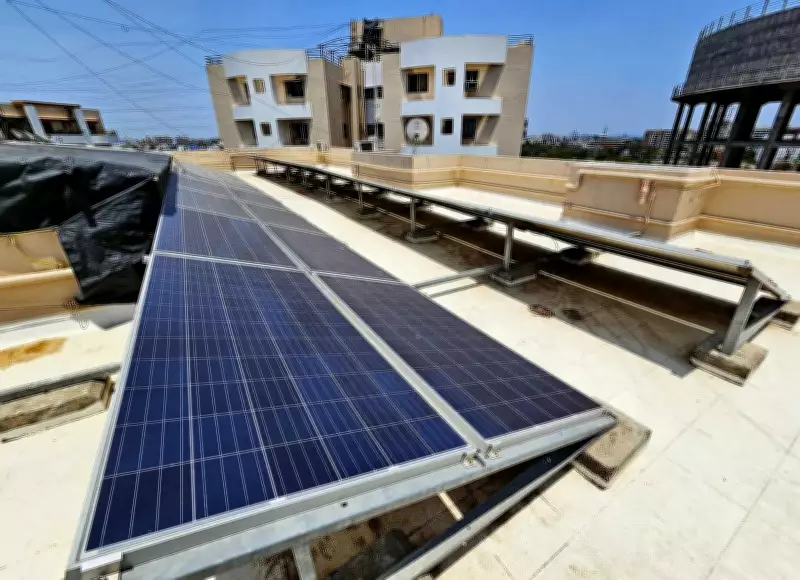
Ghaziabad Development Authority Enforces Rooftop Solar Mandate for Building Approvals
The Ghaziabad Development Authority (GDA) has introduced a stringent new regulation that makes it compulsory for all developers and plot owners to designate specific areas for rooftop solar panel installations within their building maps submitted for official approval. This groundbreaking policy is designed to accelerate the adoption of solar energy across the rapidly expanding urban landscape of Ghaziabad.
Strict Compliance and Financial Requirements
Under this mandate, building maps that fail to include provisions for solar panel installations will face immediate rejection by the authorities, ensuring strict adherence to the new green building standards. In alignment with the central government's PM Surya Ghar scheme, applicants are now required to deposit a refundable fee at the time of map approval. This fee is structured on a tiered basis according to plot size, with amounts set as follows:
- Rs 20,000 for plots measuring between 200 and 500 square metres (sqm)
- Rs 50,000 for plots ranging from 500 to 1,000 sqm
- Rs 1 lakh for plots between 1,000 and 5,000 sqm
- Rs 2 lakh for plots exceeding 5,000 sqm
The deposited fee is fully refundable upon successful verification of the solar installation during an official inspection, providing a financial incentive for timely completion of the solar projects.

Ghaziabad's Ambitious Solar City Vision
This regulatory push forms a crucial component of Ghaziabad's broader strategy to establish itself as a leading solar city in Uttar Pradesh. Among the 18 urban centers identified under the national solar cities initiative, Ghaziabad has set an ambitious target to meet 10% of its total energy requirements from renewable sources by the year 2027, according to the Uttar Pradesh New and Renewable Energy Development Agency (UPNREDA).
A comprehensive 2024 assessment conducted by UPNREDA reveals that Ghaziabad possesses a remarkable solar power generation potential of 2,858 megawatts (MW). The breakdown of this potential across different sectors highlights:
- Residential buildings leading with 2,014 MW
- Industrial sites contributing 616 MW
- Educational institutions at 73 MW
- Commercial buildings accounting for 107 MW
- Government offices with 35 MW
- Healthcare institutions at 14 MW
Currently, Ghaziabad experiences peak power demand fluctuating between 1,400 MW and 1,600 MW, indicating that solar energy could significantly offset conventional power consumption.
Economic Benefits and Government Support
Solar energy currently offers substantial cost advantages, being approximately 30% cheaper than conventional energy sources. Both state and central governments are actively promoting adoption through various subsidies and technical support programs, particularly targeting residential consumers who often face high upfront installation costs.
Property owners who generate surplus solar power can participate in net metering arrangements, allowing them to feed excess electricity back into the grid. These surplus units are then deducted from their electricity bills during billing cycles, creating opportunities for both significant savings and potential additional income through sales to power distribution companies.
The integration of solar infrastructure into building planning represents a forward-thinking approach to urban development, combining environmental sustainability with economic practicality for Ghaziabad's growing population.






