

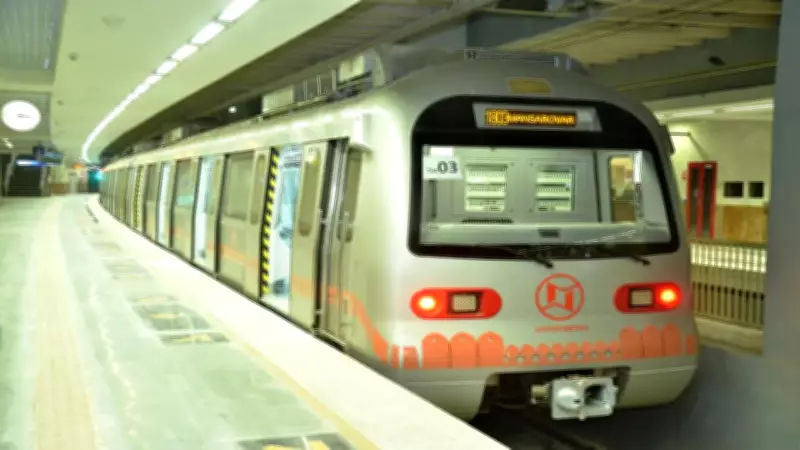
Union Cabinet Greenlights Major Jaipur Metro Expansion
The Union Cabinet has given its formal approval for the ambitious Jaipur Metro Phase-2 project, marking a significant milestone in the city's urban infrastructure development. This crucial decision was announced on Wednesday through an official government statement, clearing the path for a transformative public transport initiative.
Project Specifications and Strategic Importance
The approved Phase-2 comprises a substantial 41-kilometer North-South corridor stretching from Prahladpura to Todi Mod, featuring an extensive network of 36 strategically located stations. The project carries a substantial financial commitment of Rs 13,037.66 crore, reflecting the government's dedication to enhancing urban mobility infrastructure.
Implementation responsibility falls to the Rajasthan Metro Rail Corporation Limited (RMRCL), a balanced 50:50 joint venture partnership between the Central Government and the Rajasthan State Government. This collaborative structure ensures shared investment and oversight throughout the project lifecycle.

Comprehensive Connectivity and Network Integration
The new corridor is designed to provide what officials describe as "seamless connectivity" to numerous critical nodes across Jaipur. Key areas set to benefit include the Sitapura Industrial Area, VKIA (Vishwakarma Industrial Area), Jaipur Airport, Tonk Road, SMS Hospital, Ambabari, and Vidhyadhar Nagar. This strategic routing ensures the metro serves both commercial hubs and residential communities.
A notable feature includes underground stations in proximity to the airport, enhancing accessibility for air travelers. Crucially, Phase-2 will integrate thoroughly with the existing Phase-1 infrastructure through carefully planned interchanges and feeder systems. This integration creates a unified, comprehensive metro network spanning Jaipur, allowing passengers to transfer smoothly between different lines.
Ridership Projections and Current Performance
Currently, Jaipur Metro Phase-1 operates an 11.64-kilometer East-West corridor connecting Mansarovar to Badi Chaupar, serving approximately 60,000 passengers daily. With the addition of Phase-2's extensive network, transportation authorities anticipate a "manifold increase" in overall ridership numbers.
This expansion is expected to substantially boost the share of public transportation in Jaipur's mobility ecosystem while simultaneously reducing dependence on private vehicles. The shift promises multiple benefits for the city's transportation dynamics and environmental footprint.
Financial Viability and Funding Structure
The project has successfully navigated multiple rigorous appraisal stages, demonstrating strong economic fundamentals. It boasts an impressive Economic Internal Rate of Return (EIRR) exceeding 14%, indicating robust socio-economic viability and promising returns on public investment.
Funding will be secured through a multi-tiered approach aligned with the Metro Rail Policy of 2017. This includes equity support from both the Central and State governments, supplemented by subordinate debt arrangements and multilateral financing from international development institutions. This diversified funding model ensures financial stability throughout the construction phase.
Strategic Alignment and Implementation Timeline
Jaipur Metro Phase-2 is strategically aligned with Rajasthan's Transit-Oriented Development (TOD) Policy-2025 and broader national urban mobility objectives. The project has a targeted completion date set for September 2031, providing a clear timeline for implementation.
Upon completion, the expanded metro network is projected to deliver substantial urban benefits including reduced traffic congestion, decreased vehicular emissions, and enhanced overall mobility across Jaipur. The project represents a forward-looking investment in sustainable urban development that will shape the city's transportation landscape for decades to come.






