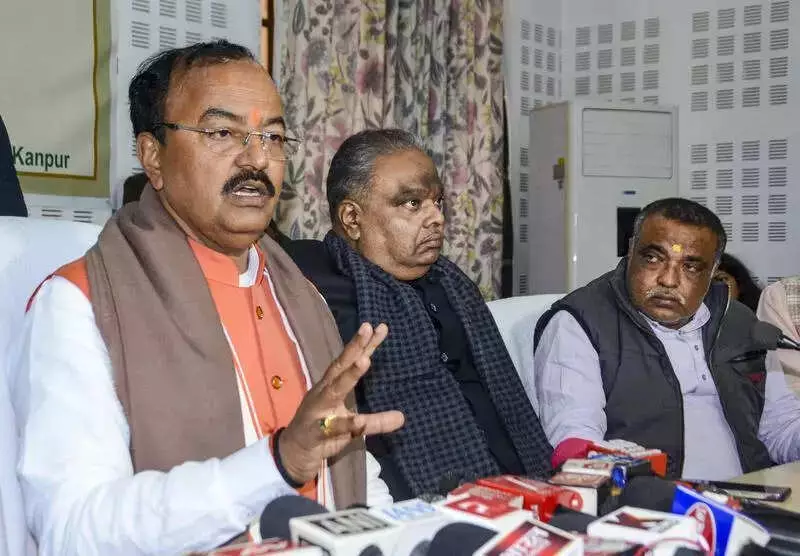
Deputy Chief Minister of Uttar Pradesh, Keshav Prasad Maurya, has strongly defended the central government's newly launched G-Ram-G scheme, positioning it as a transformative initiative to eradicate corruption and fast-track development in rural India. He made these remarks during a press conference held at the auditorium of Chandra Shekhar Azad University of Agriculture and Technology in Kanpur on Tuesday.
Allegations of Past Corruption and New Safeguards
Launching a sharp attack on previous governments, Maurya alleged that more than Rs 12,000 crore was embezzled through the Mahatma Gandhi National Rural Employment Guarantee Act (MNREGA) during Congress-led administrations. He accused the Congress and its affiliated voluntary organisations of indulging in widespread corruption within the scheme.
He credited Prime Minister Narendra Modi with introducing the G-Ram-G (Garib Kalyan, Rojgar, and Gramin Vikas) to put an end to such malpractices in MNREGA, calling it a major achievement towards a corruption-free India. Maurya stated that the new law is a meaningful step in this direction, designed to bring transparency and efficiency.

Key Benefits and Structural Changes of G-Ram-G
Outlining the advantages of the new scheme, Maurya highlighted several key improvements over the old MNREGA framework:
- Increased Employment Days: Village workers will now be guaranteed employment for 125 days per year, a significant increase from the earlier 100-day guarantee.
- Integration of Agricultural Work: Acknowledging the clash between MNREGA work and farming seasons, Maurya explained that 60 days of agricultural work would now be available under G-Ram-G, ensuring laborers do not miss out on income.
- Broader Development Scope: He criticized the earlier model where "only digging and filling of pits was done," stating that under G-Ram-G, comprehensive village development works like constructing roads, drains, and other infrastructure would be carried out.
- Categorization of Villages: For more targeted development, villages will now be divided into three distinct categories under the new scheme.
- Enhanced Institutional Work: Maurya gave an example that if earlier only boundary walls were built in village schools, now facilities like laboratories could also be constructed under G-Ram-G.
- Streamlined Documentation: The system of job cards has been reformed. Instead of 5-year cards made for "favoured people," 3-year cards will be issued and renewed every three years to ensure wider and fairer coverage.
He emphasized that the scheme would eliminate overlapping in village development works and create substantial employment opportunities.
Political Counterattack and Future Projections
Maurya did not hold back in his political critique, dismissing the opposition's concerns about changes to MNREGA as "baseless allegations" aimed at spreading confusion about the G-Ram-G scheme.
Turning his focus to state politics, he took a swipe at Samajwadi Party chief Akhilesh Yadav, who has been projecting himself for the 2027 state elections. "Akhilesh became flustered after the Bihar results came out and all his arrogance would be shattered in 2027," Maurya declared. He added that while the opposition might win a seat like Safai, winning Lucknow (the seat of power) was beyond their capability.
The Deputy CM's press conference served to vigorously promote the central government's flagship rural welfare scheme while firmly setting the political narrative for the upcoming electoral battles in Uttar Pradesh.