Madhya Pradesh's Electric Vehicle Charging Stations Operate Without State Regulations
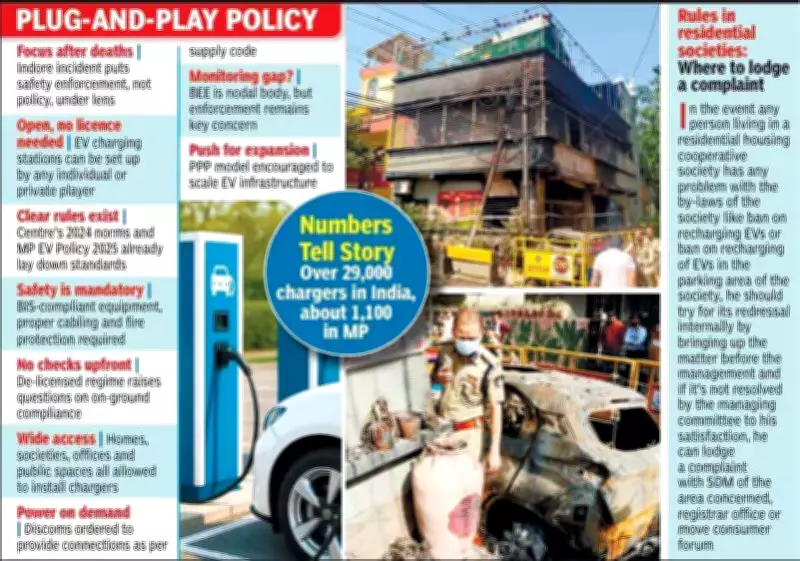
In a startling revelation, it has come to light that there are no specific rules or regulations governing the establishment of Electric Vehicle Charging Stations (EVCSs) in Madhya Pradesh. This regulatory gap has gained urgent attention following a devastating fire in Indore, which is suspected to have originated from a short-circuit during the charging of an electric vehicle hatchback, resulting in the tragic loss of eight lives.
Central Guidelines Define EVCS Setup as 'De-Licensed' Activity
The Union Ministry of Road Transport and Highways has clarified that installing EV charging stations is considered a 'de-licensed' activity in Madhya Pradesh. This means private players are free to set up EVCSs in accordance with the central government guidelines issued by the Ministry of Power in 2024. According to the Union ministry, "Setting up of a charging station is an unlicensed activity and private players can install Electric Vehicle Charging Stations (EVCSs) as per guidelines issued by union govt in the ministry of power in 2024. The guidelines encourage PPP models for scaling infrastructure."
Madhya Pradesh Electric Vehicle Policy 2025 Aligns with Central Mandate
In line with the Union government's directive, the Madhya Pradesh Electric Vehicle Policy 2025 explicitly states that the establishment of public charging stations (PCS) shall be a de-licensed activity. The policy asserts, "Setting up of public charging stations (PCS) shall be a de-licensed activity and any individual/entity is free to set up public charging stations, provided that, such stations meet the technical as well as performance standards and protocols laid down below as well as norms/standards/specifications laid down by ministry of power, central electricity authority, govt of MP from time to time."

Detailed Infrastructure and Safety Guidelines from Ministry of Power
The guidelines issued by the Union Ministry of Power in 2024 provide comprehensive details on infrastructure and power connections for various EV charging stations in both commercial and residential areas. These cover private, visitor, and public vehicles, with specific technical specifications outlined for safety and efficiency.
Key Safety and Compliance Requirements:- All electric vehicle supply equipment must comply with Bureau of Indian Standards (BIS) standards.
- Charging point operators may apply for electricity connections for their EV charging stations.
- Commercial building owners can select types and numbers of workplace EV chargers based on employee needs.
- Group housing societies and residential welfare associations are permitted to establish EV charging stations within their premises.
- Residents can decide on the types and number of community EV chargers to be installed.
- Community stations may be equipped to allow charging for authorized visitor vehicles.
- Residents can install private EV charging stations in their designated parking spaces.
Monitoring and Implementation Framework
According to the norms established by the Union Ministry of Power, the Bureau of Energy Efficiency (BEE) will serve as the central nodal authority to monitor the implementation of these guidelines. All relevant agencies, including electricity distribution companies (DISCOMs), are expected to cooperate and provide necessary support. The Central Electricity Authority (CEA) and state government agencies are also mandated to assist BEE in enforcing Indian Standards for EV chargers as notified by BIS.
Safety Protocols and Electrical Compliance
The safety requirements for EVs include appropriate cabling and electrical work to ensure safety, along with adequate fire protection equipment and facilities installed as per relevant Indian standards. Electrical equipment installed in EV charging stations must comply with Central Electricity Authority regulations, specifically the technical standards for connectivity of distributed generation resources (2013) and safety and electric supply measures (2023), as amended periodically.

State-Level Implementation and Infrastructure Status
The Urban Development and Housing Department has been designated as the nodal department for the implementation of the Madhya Pradesh Electric Vehicle Policy 2025, or as decided by the state government. Meanwhile, the MP Power Management Company Ltd. acts as the state nodal agency for EV charging infrastructure. The distribution licensee is required to provide electricity connections "as per provisions of the MP electricity supply code 2021, notified by MP electricity regulatory commission and as amended from time to time to any entity/ charge point operator (CPO) seeking to set up a public EV charging station/battery swapping station."
As per central government data, there are a total of 29,151 EV charging stations across the country, with Madhya Pradesh accounting for just 1,146 of these. This relatively low number underscores the need for accelerated infrastructure development, even as the absence of state-specific regulations raises questions about oversight and safety in the wake of incidents like the Indore fire.