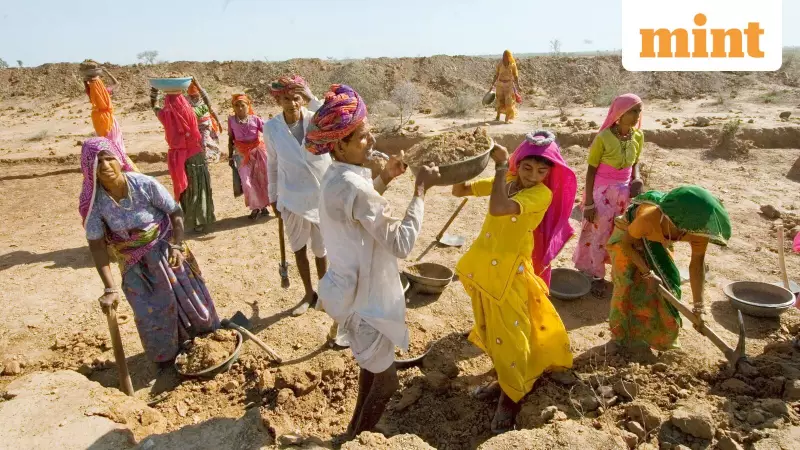
The Indian government has tabled a landmark bill in Parliament to overhaul the country's flagship rural jobs program, promising more work days but triggering a political storm over funding and federal principles. The Viksit Bharat–Guarantee for Rozgar and Ajeevika Mission (Gramin) Bill, 2025, introduced in the Lok Sabha on Tuesday, seeks to replace the two-decade-old Mahatma Gandhi National Rural Employment Guarantee Act (MGNREGA).
Key Provisions and Increased Work Days
The proposed legislation, presented by Rural Development Minister Shivraj Singh Chouhan, aims to provide a statutory guarantee of 125 days of wage employment per financial year to each rural household. This marks an increase from the current guarantee of 100 days under MGNREGA. The government plans to roll out the revamped scheme across the country from April next year.
States will be required to prepare detailed implementation plans within six months of the law coming into force. A pivotal change lies in the funding structure. The scheme will operate as a centrally-sponsored program, with the Union government bearing 90% of the cost for north-eastern and Himalayan states and Union territories. For all other states, the Centre's share will be 60%, with the respective state governments required to fund the remaining portion.

Financial Implications and Political Opposition
According to government estimates, if the scheme is implemented nationwide for the full 125 days from the next financial year, the total annual fund requirement would be approximately ₹1.51 trillion. The central share of this massive outlay is estimated at ₹95,692.30 crore.
However, the bill has faced fierce criticism from Opposition parties and rights activists. They argue that the new cost-sharing model fundamentally alters the scheme's nature and burdens state finances. Nikhil Dey, a founding member of the Mazdoor Kisan Shakti Sangathan, labeled the bill a dilution of labor rights, stating it converts a demand-based guarantee into an allocation-based program controlled by the Centre.
Opposition members, including Congress's Priyanka Gandhi and TMC's Saugata Roy, protested the bill's introduction, demanding it be sent to a parliamentary committee for review. They contended that the legislation puts immense pressure on state finances and undermines the constitutional framework.
New Framework and Digital Focus
Beyond the funding debate, the VB G RAM G Bill introduces a new planning and execution architecture. All rural works will be integrated into a unified Viksit Bharat National Rural Infrastructure Stack, creating a single national framework. Planning will be anchored in Viksit Gram Panchayat Plans (VGPPs), prepared using spatial technologies and integrated with the PM Gati Shakti platform for coordinated development.
The bill emphasizes digital governance and transparency, mandating the use of biometric authentication, real-time dashboards, and AI-enabled analytics. It also allows states to notify up to 60 days during peak agricultural seasons when work under the scheme will not be offered, a provision critics say could deny employment when it's needed most.
While the government frames the bill as a step towards holistic village development, the coming months will see intense debate on whether the promise of 125 days of work is strengthened or weakened by the proposed financial and structural changes.